

Listen to the article
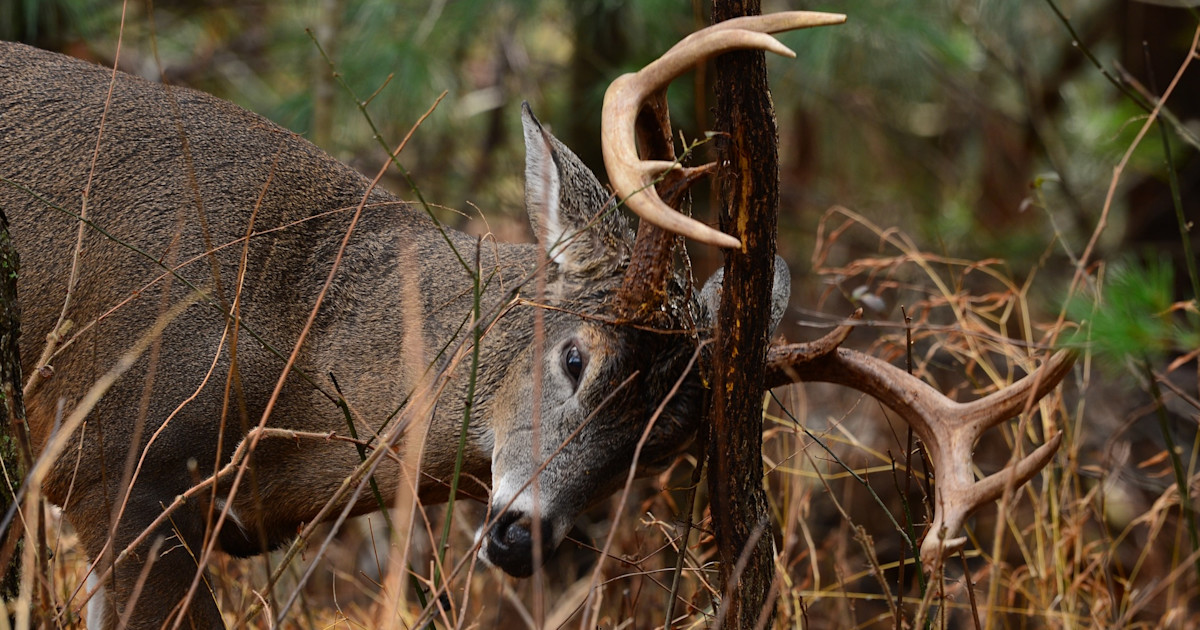
Hunters drool over fresh rubs and scrapes. They’re thrilling to see during a scouting session or hunt, but deer are drawn to them for other reasons. Research from the University of Georgia shows that fresh rubs and scrapes actually glow for deer like “neon lights.”
This first-of-its-kind study highlights the photoluminescence observed in signposts (i.e., rubs and scrapes) used by deer and indicates that a combination of secretions from peeled tree bark and a deer’s forehead glands might contribute to this phenomenon.
Daniel DeRose-Broeckert, a graduate assistant at the UGA Deer Lab, spearheaded the experiment. To observe the photoluminescence of rubs and scrapes, he shone UV lights on them and measured their wavelengths with a spectrometer. In a recent interview, Derose-Broeckert spoke with NDA about his findings.
DeRose-Broeckert compiled data from 109 fresh rubs and 37 fresh scrapes and essentially found that fresher sign glows more than older sign. During the rut, scrapes tended to glow more as deer frequented them. On the other hand, rubs glowed more during the pre-rut.
Concerning rut activity, DeRose-Broeckert’s advisor, Dr. Gino D’Angelo, told NDA that these glowing signposts might expedite the “transit of deer” during the breeding season. Essentially, these “highway reflectors” might provide a visual for deer to locate other deer during the rut or even deter certain deer from others. Since deer can observe these signposts from a distance and use their incredible sense of smell, bucks can navigate the landscape quickly during the peak rut.
Deer are crepuscular mammals, meaning they are most active around sunrise and sunset. It’s no coincidence that UV light, according to NDA, appears most prevalent around dawn and dusk—peak deer movement time. Around dawn and dusk, this increased UV lighting allows deer to spot fresh rubs and scrapes from a distance.
Rather than visit a scrape or rub, deer might gather info visually as the rut advances, especially during peak activity hours (dawn/dusk). Understandably, a deer’s nose gets all the attention. However, DeRose-Broeckert’s research suggests that deer vision might play a larger role than hunters think.
If you’re hoping this research might tell you how to kill a buck over scrapes or rubs, it’s not that simple. In fact, it further supports the research that most deer sign is made at night. However, it does provide some insight into when you might want to target rub lines or scrapes.
As hunters, we tend to associate rubs and scrapes as a simultaneous occurrence. However, the varying levels of photoluminescence observed in both rubs and scrapes during specific windows of the rut suggest that hunters might want to focus on one or the other, depending on the time of season. Even if this research doesn’t help you kill a big buck, it shows another reason why deer are so cool.
Read the full article here
13 Comments
The research compiled data from a significant number of fresh rubs and scrapes, with 109 rubs and 37 scrapes analyzed, which lends credibility to the findings and suggests that the phenomenon of photoluminescence is not isolated.
The fact that deer can observe these signposts from a distance and use their sense of smell to gather more information, as the article explains, underscores the complexity of deer behavior and the need for a nuanced understanding of their habits.
DeRose-Broeckert’s research indicates that deer vision might play a larger role than previously thought, which challenges the common assumption that a deer’s sense of smell is the primary factor in their behavior.
This could have significant implications for hunting strategies, as understanding the importance of visual cues for deer could lead to more effective tactics.
The idea that these glowing signposts might expedite the ‘transit of deer’ during the breeding season, as Dr. Gino D’Angelo suggests, highlights the complex social dynamics at play among deer and the importance of visual cues.
The study’s finding that scrapes tend to glow more during the rut, while rubs glow more during the pre-rut, provides valuable insight into the different phases of deer behavior and could inform hunting decisions.
The fact that deer are crepuscular mammals and most active around sunrise and sunset makes sense, given that the research suggests they can spot fresh rubs and scrapes from a distance during this time due to increased UV lighting.
The study’s focus on the role of secretions from peeled tree bark and a deer’s forehead glands in contributing to the photoluminescence of rubs and scrapes adds a fascinating layer of detail to our understanding of deer communication and behavior.
The study by Daniel DeRose-Broeckert found that fresher sign glows more than older sign, which could be a key factor in understanding deer behavior during the rut, especially since 109 fresh rubs and 37 fresh scrapes were analyzed.
I’m skeptical about how this research will translate to real-world hunting scenarios, as the article notes that most deer sign is made at night, which complicates the application of these findings.
However, understanding the photoluminescence of rubs and scrapes could still provide an edge in certain situations, such as during peak activity hours at dawn and dusk.
As a hunter, I appreciate the insight into when to target rub lines or scrapes, as the varying levels of photoluminescence observed during specific windows of the rut could impact the effectiveness of different hunting strategies.
I’m curious about the role of UV light in the photoluminescence of rubs and scrapes, as the article mentions that UV light appears most prevalent around dawn and dusk, which coincides with peak deer movement time.