

Listen to the article
At the very end of an impressive row of firearms that terminated right behind the cashier sat an odd and lonely little double-barrel scattergun. It looked out of place in terms of both size and technology, just a relatively small amalgamation of blued steel and walnut, its price tag dangling from a white string tied to the trigger guard. I smiled.
“May I see the coach gun?” I asked the clerk manning the register.
“No,” he said, inexplicably arching his brows. He’d been friendly and accommodating until then, so I was briefly taken aback by his refusal. I guess he must’ve sized me up as a good guy, though, because—after quickly glancing around—he leaned forward and conspiratorially whispered “That’s the store gun, and it’s loaded.”
Genius. They had hidden their primary defensive tool in plain sight just by affixing a price tag to it and setting it next to all the other long guns. Although each employee carried a sidearm, whoever was on the cash register also had immediate access to two blasts of buckshot from what a crook would assume was an empty gun.
It also meant that, among this vast array of advanced, consumer firearms, a little 19th-century-style coach gun offered the best combination of compactness, handling, reliability, simplicity and power to initiate defense of the store and its employees.
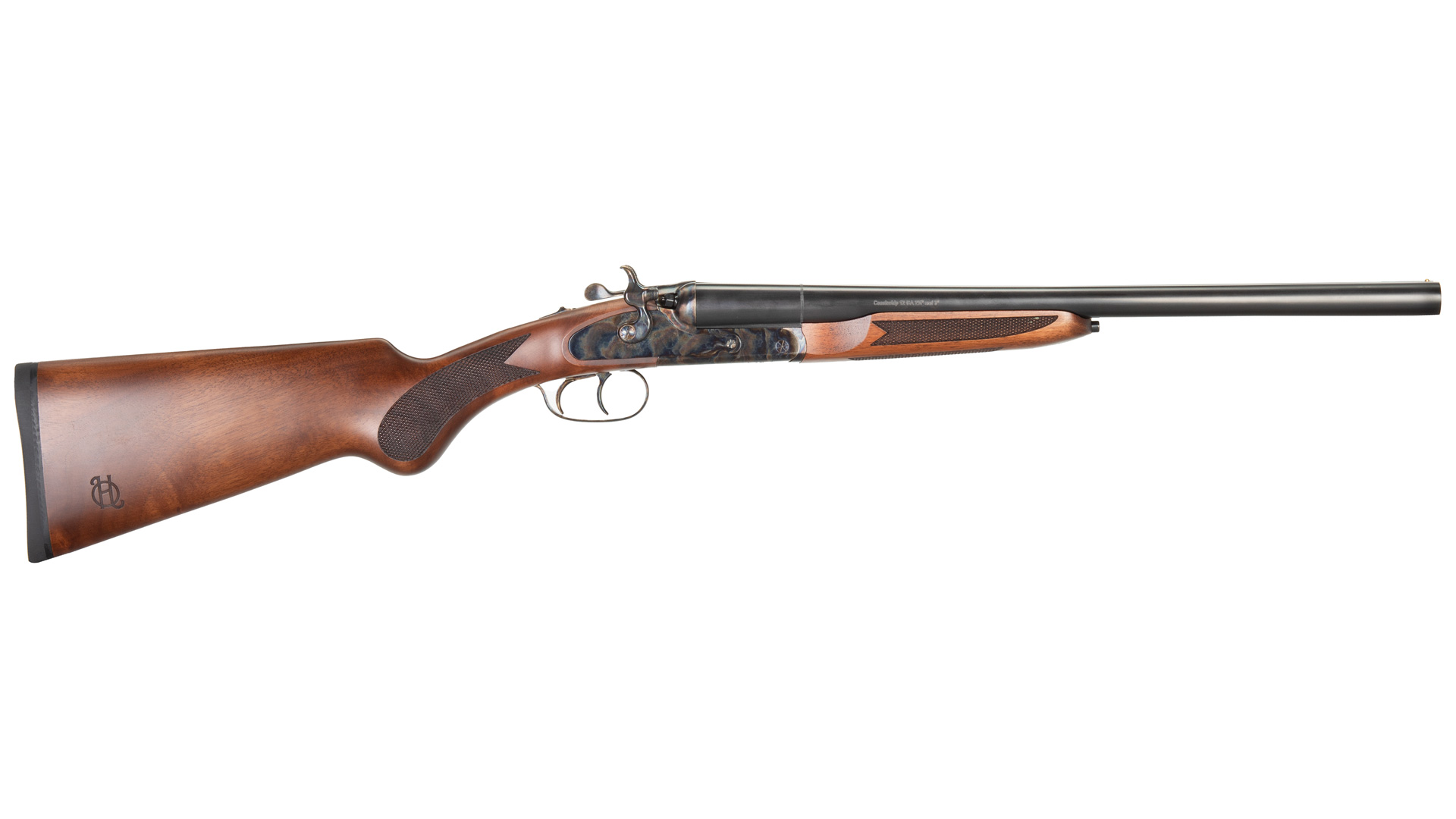
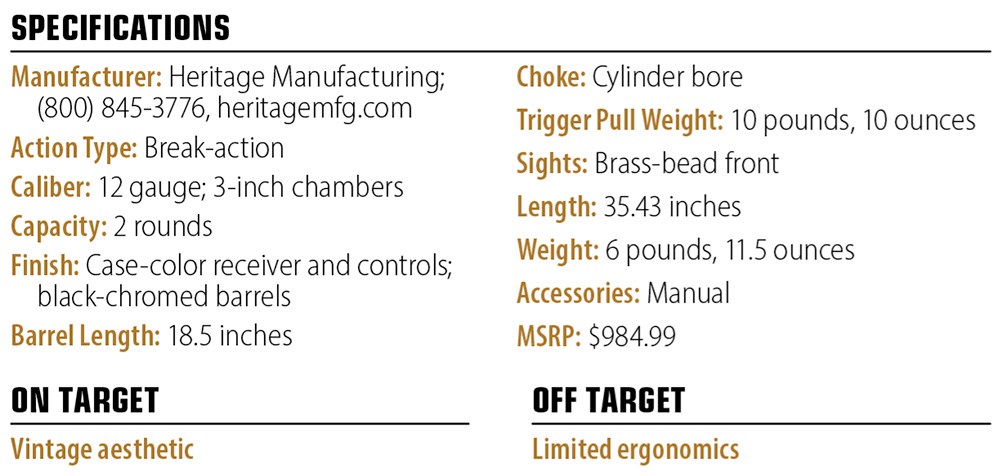
Heritage Manufacturing’s new Coachwhip is an extraordinarily handsome rendering of a coach gun. With a Prince-of-Wales grip, splinter fore-end, black-chromed barrels and case-colored receiver, hammers, trigger guard and double triggers, it’s a looker. Of course, looks alone won’t carry the day in a fight—but twin 3-inch, 12-gauge chambers will.
Once you stipulate to the gun lacking firepower, it is otherwise easy to champion the virtues of a coach gun as a defensive arm. First and foremost, it’s a 12-gauge shotgun, long the gold standard of short-range, defensive longarms. But, the other thing about a coach gun is that it’s almost foolproof for those first two shots because there is no cycling. You load the chambers directly; the shells are already in there and await only the fall of the hammers for ignition of the primers.
Hinge the buttstock on your shoulder, angling down the 18.5-inch barrels to the low-ready when moving (especially around corners), then quickly lever up the gun, if and when needed. If you have to maneuver indoors, there are few longarms that can do it as well, and no pistol can match the muzzle energy of those two loads of buckshot.
The Coachwhip has barrels long enough to avoid NFA restrictions on short-barreled shotguns • Case coloring on the receiver, triggers, trigger guard and hammers is nothing short of stunning • Move the barrel-release latch to either side to open the action. All controls actuated easily, for a new gun • A brass bead is a sim- ple and traditional alternative to an optic or even rifle sights—and is all that is needed • Rabbit-ear exposed hammers are easy to cock and make the condition of the shotgun plain to see in an instant.
Authentic coach guns follow the KISS design principle (Keep It Simple, Stupid). There are no lights, lasers or electro-optics, and no means to readily affix them. One of the virtues of the Coachwhip is that all the controls are located close together, making them easy to manipulate without having to move your hand too far from the operating position. The barrel latch, rabbit-ear exposed hammers and tang-mounted safety are right below your line-of-sight and the triggers are right there underneath. All controls actuated positively and without undue stiffness, given this was a brand-new gun. They got even smoother with use, but were pretty good right out of the box.
The downside of the Coachwhip is really a problem inherent to coach guns. Once the two shots are out of the barrel, the reload is, uh, labor intensive. You must thumb the barrel latch and break open the action. The Coachwhip has no ejectors, so you’ll have to pluck out the empties with your fingers, grab two more shells and insert them in the chambers, snap the action shut, then cock the hammers and get back on the triggers. That’s a lot to do under stress. The hope is those first two shots would solve the great majority of problems.
The other concern is settling on a condition for storage if this is your primary home-defense gun. Do you keep it loaded and, if so, with the hammers down or cocked? And with the safety on or off? It requires some thought and once you make a choice, you’ll need to commit it to muscle memory to be able to use the gun quickly and effectively.
At the range, the gun demonstrated the expected reliability. There’s really not a lot to go wrong. There was no spread with 00 buck at 5 yards, just a single hole. Depending on the load, pellets struck 2 to 5 inches above point-of-aim at 7 yards, so know where your preferred load hits should you invest in a Coachwhip. Firing at 10 yards with No. 4 buck produced about an 11-inch spread. Best all-around performance was achieved with 2 3/4-inch No. 1 buckshot. Three-inch loads didn’t produce a conceivable advantage for home defense, unless you are expecting a grizzly to break down your door.
Some will find it nitpicky, given this is a coach gun, but it doesn’t leap to your shoulder the way a high-end sporting shotgun will. But, of course, what does? Also, shooting a high volume of shells through the Coachwhip was no fun—nor should you expect it to be. This is not a gun for sporting clays or trap. Yes, recoil is stiff, but in a defensive use, you’ll never notice, and the gun is controllable, if not pleasant.
In addition to home defense, the Coachwhip will likely pique the interest of cowboy-action shooting participants. If you like retro firearms, or you feel a coach gun’s tactical advantages outweigh its liabilities, the Heritage Manufacturing Coachwhip is a particularly fine example of one. And while you may blessedly never have to use it except for familiarization or fun, you’ll still have something quite nice to look at.
Read the full article here
26 Comments
I’m skeptical about the effectiveness of a coach gun in modern defensive scenarios, given the advancements in firearm technology – can it really compete with more modern designs?
While it may not have the firepower of some modern firearms, the Coachwhip’s compactness, reliability, and the power of two 3-inch, 12-gauge chambers make it a viable option for close-quarters defense.
The Prince-of-Wales grip and splinter fore-end on the Coachwhip give it a classic look, but I’m more interested in how these features affect the gun’s handling and ergonomics.
The use of a brass bead as a sighting system is a simple yet effective choice for a coach gun like the Coachwhip, especially at close range where speed is more important than precision.
The action of moving the barrel-release latch to either side to open the action seems intuitive, but I wonder if it could be improved or if it’s sufficient as is for quick reloads.
The concept of hiding a defensive firearm in plain sight, as described with the store gun, is genius – it completely changes the perception of what a defensive firearm should look like or where it should be kept.
The fact that each employee carried a sidearm but also had access to the Coachwhip as a ‘store gun’ highlights the versatility and potential of this firearm in different defensive scenarios.
The Coachwhip’s ability to maneuver indoors, especially around corners, due to its compact size and design, makes it an attractive option for home defense or in tight spaces.
The article’s point about the Coachwhip offering the best combination of compactness, handling, reliability, simplicity, and power for initiating defense is well-taken, especially in contexts where these factors are crucial.
The fact that the Heritage Manufacturing Coachwhip Shotgun has an 18.5-inch barrel, avoiding NFA restrictions on short-barreled shotguns, is a significant advantage for those looking for a compact yet powerful defensive arm.
The rabbit-ear exposed hammers are not only aesthetically pleasing but also practical, making it easy to cock the gun – a feature that adds to the overall usability of the Coachwhip.
The case coloring on the receiver, triggers, trigger guard, and hammers of the Coachwhip is a beautiful touch, but I wonder how it holds up to heavy use and potential scratches or wear.
I’ve found that the case coloring on similar firearms has held up surprisingly well, even with regular use, due to the durable nature of the finish.
While the Coachwhip may lack the firepower of some modern firearms, its strengths in close-quarters defense and its historical provenance make it an intriguing option for those looking for something different.
I’m intrigued by the idea of a coach gun being used as a defensive tool, especially with its simplicity and reliability – the lack of cycling needed for the first two shots is a major plus in high-stress situations.
I’m curious about the potential for customization or aftermarket support for the Coachwhip, considering its unique design and the growing interest in defensive firearms.
The historical and practical context provided for coach guns, including their use on stagecoaches and their effectiveness in close quarters, adds depth to the discussion of the Coachwhip’s potential as a modern defensive firearm.
In comparing the Coachwhip to other defensive firearms, its ability to provide a significant amount of power in a compact package is a compelling argument for its consideration in certain defensive roles.
The use of black-chromed barrels and the overall aesthetic of the Coachwhip make it stand out, but it’s the performance and practicality that will ultimately determine its value as a defensive firearm.
The mention of the Coachwhip being an ‘extraordinarily handsome rendering of a coach gun’ is not just about aesthetics; it speaks to the care and attention to detail in its design and manufacture.
I appreciate the mention of the gun’s simplicity and the fact that it’s ‘almost foolproof for those first two shots’ – this could be a significant advantage for those less experienced with firearms.
I find it interesting that the clerk’s initial refusal to show the Coachwhip, followed by the revelation that it was loaded and served as the store’s defensive gun, underscores the element of surprise and strategy in defense.
The comparison between the Coachwhip and pistols in terms of muzzle energy is striking – the power of two loads of buckshot is certainly not something to underestimate.
For those considering the Coachwhip or similar firearms for defense, it’s crucial to weigh the benefits of its design against the need for training and practice to effectively utilize its unique features.
Given the historical context and design of coach guns, it’s fascinating to see how the Coachwhip blends traditional elements with modern manufacturing, creating a unique defensive firearm.
For those who might not be familiar, the term ‘coach gun’ originates from its historical use as a defensive firearm on stagecoaches, highlighting its effectiveness in close-quarters situations.