

Listen to the article
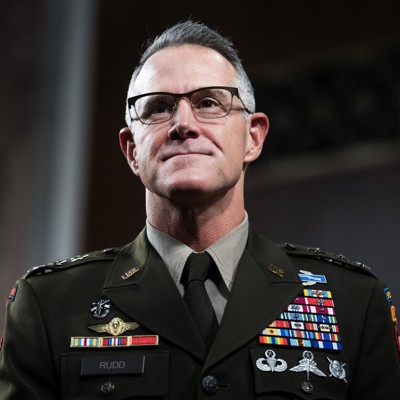
President Donald Trump’s pick to lead U.S. Cyber Command and the National Security Agency told senators Thursday that his experience working with cyber intelligence in the Indo-Pacific qualifies him to serve in the dual-hatted role, though he notably stopped short of directly endorsing policy proposals for more aggressive cyber responses to China and other foreign adversaries.
Lt. Gen. Josh Rudd’s relative lack of direct experience in military cybersecurity and signals intelligence was raised multiple times when he testified before the Senate Armed Services Committee on Thursday. Currently the deputy commander of U.S. Indo-Pacific Command, Rudd has spent his career largely in special operations and joint command roles. Some former officials and China analysts view Rudd’s Indo-Pacific background as relevant to U.S. cyber operations involving Beijing.
In his opening testimony, Rudd said he has frequently used cyber intelligence findings produced by the organizations he is nominated to lead.
“For decades, I have had the opportunity to be a leader, consumer, enabler, generator and integrator of the intelligence and operational capabilities of the NSA and Cyber Command,” he told senators.
“I’m confident that the incredible talent at Cyber Com-NSA will provide great advice,” Rudd added. “I’m confident that, if confirmed, I can continue to lead and enable those two organizations to provide the best support to our combat commanders in the joint force, writ large.”
The dual-hat arrangement of NSA and Cyber Command has been a frequent topic of debate among cyber policy practitioners, who have argued over whether the agencies should be led by two different officials. The fiscal 2026 defense policy package kept in place the current arrangement for now, but it is possible that may be revisited in future efforts.
Rudd told several senators that his goal would be to remain “objective” about the dual-hat policy. He told committee chairman Roger Wicker, R-Miss., however, that the current buildout creates “unity of command and unity of effort” across the two organizations and provides an effectiveness that fosters the speed needed to respond to current cyber threats from adversaries.
Sen. Jeanne Shaheen, D-N.H., asked Rudd about election security, and how he’d manage Cyber Command during a midterm election year amid governmentwide staffing reductions within federal cyber offices.
“Any foreign attempt to undermine the American process of democracy … has got to be safeguarded. It’s absolutely a fundamental priority for the nation,” Rudd told Shaheen. He said his experience working across interagency processes would help in efforts to protect upcoming elections, though he said he isn’t sure what direct role Cyber Command would play in the future and would “continue to prioritize that as directed.”
Rudd was not asked directly about Section 702 of the Foreign Intelligence Surveillance Act, a major surveillance authority in the NSA’s toolbox that expires in April unless reauthorized by Congress. Civil-society groups have said the authority allows too much collection and querying of Americans’ communications.
In written testimony to the committee, he said he had “limited familiarity” with details of the statute’s collection processes, but said he has viewed intelligence derived from 702 findings.
Intelligence officials have historically supported reauthorizing the statute, while opposing a warrant requirement long sought by civil liberties organizations. The law allows the NSA to target foreigners’ communications abroad without a warrant for foreign intelligence purposes, though it permits the incidental collection of U.S. persons’ communications.
“As a current customer of FISA Section 702-derived intelligence products, I recognize how this authority is used every day to protect the nation from current and emerging threats by providing critical insights on key adversaries,” he said. “However, I would defer to the administration to fully characterize the value of this authority. If confirmed, I fully commit to working with Congress on all matters related to this authority.”
Rudd didn’t directly answer questions from Sen. Angus King, I-Maine, about whether NSA and Cyber Command should develop an offensive cyber deterrence policy. More aggressive, gloves-off cyber offense has been talked up by current administration officials for the last year amid major Chinese cyber intrusions into U.S. telecom systems and other critical infrastructure.
“Senator I don’t know if that’s my role to have that opinion,” Rudd said, adding that it’s his job to develop cyber options that “deliver deterrence” that would be the most effective.
“I’m confused, because you’re nominated to be the top cyber officer in the United States government,” King replied. “And you don’t have an opinion on cyber policy or what’s important? Are you simply a lever puller? I really don’t understand.” King added he found the responses “disappointing.”
Sen. Elissa Slotkin, D-Mich., also asked Rudd to provide affirmation that NSA capabilities won’t be used for domestic spying purposes, amid a Trump administration-wide effort to crack down on supposed domestic terrorist groups.
“Senator, if confirmed, I will execute my responsibilities in accordance with the constitution and all applicable laws,” Rudd said.
He also agreed to work with Sen. Jacky Rosen, D-Nev., on finding ways to develop and enhance the U.S. cyber workforce.
Rudd is expected to testify before the Senate Intelligence Committee — which also has jurisdiction over his nomination — in two weeks and is unlikely to face major confirmation hurdles given the GOP majority in the high chamber.
NSA and Cyber Command have been without a permanent leader for months, after far-right activist Laura Loomer pushed for the firing of their previous leader, Gen. Timothy Haugh, in April. Since then, Lt. Gen. William Hartman has led the agency in an acting capacity. Hartman is expected to retire shortly after a permanent leader steps into the position, two people familiar with the matter have said.
Rudd, if confirmed, will also have to contend with declining morale inside the spy agency, as well as significant workforce cuts that were influenced by Trump 2.0 efforts to shed government bloat and spending waste.
Read the full article here
6 Comments
Great insights on Defense. Thanks for sharing!
Interesting update on Rudd defends qualifications to lead NSA, Cyber Command at confirmation hearing. Looking forward to seeing how this develops.
Solid analysis. Will be watching this space.
I’ve been following this closely. Good to see the latest updates.
Good point. Watching closely.
This is very helpful information. Appreciate the detailed analysis.