

Listen to the article
If you are preparing for military service that involves intense physical training, you will want to be a cardio machine. Here are three standard methods of movement in the military: running, rucking and swimming. Depending on your job and branch of service, you may need to prepare only for running and rucking, but swimming is also used in some jobs and makes for a great non-impact cardio activity regardless.
The following workouts are more about building aerobic and anaerobic systems for longer-distance movement than for shorter-distance timed events, such as fitness tests — though you will see longer-distance runs, rucks, and swims in your training and operations, depending on the job you choose:
Run Workouts
You will have to perform timed runs of various shorter distances, depending on your branch of service, ranging from 1.5 to 3 miles. If you are preparing for special programs, you may need to train for longer runs of 4, 5, 6 or more miles. These require a combination of aerobic base training and goal pace/tempo training at a set pace to reach your goal.
400- and 800-Meter Repetitions
For shorter timed runs, work on your 400-meter, 800-meter, and mile repeats at your goal mile pace for your next timed run. If you currently run an 8-minute mile and want to get your run down to a 7-minute mile for your timed run distance, try the following:
Repeat 6 times:
- Run 400 meters at 1:45 (7-minute-mile pace)
- Walk 100 meters (recovery)
When that gets easy, try 800-meter repeats:
Repeat 3-4 times:
- Run 800 meters at 3:30 (7-minute-mile pace)
- Walk 100-150 meters (recovery)
Sprinting and Shuttle Runs
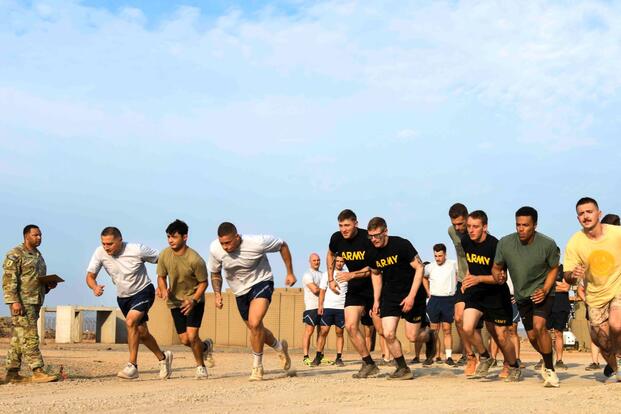
Sprinting and shuttle runs will also be part of training and testing for some units. Learning how to pick up the pace with faster runs, stopping quickly, changing directions and hurdling obstacles as well. Here are some favorite workouts to help:
Repeat 10 times:
- Run 25 meters fast; turn around quickly
- Run 25 meters fast back to the starting line
- Rest 10 seconds
Increase the Distance on Sprints
This workout helps with speed training and overall conditioning. If 10 sets gets easy, continue to 15-20 sets.
Repeat 10 times:
- Run 100 meters fast
- Run 100 meters easy
- Repeat every minute on the minute (EMOM)
Swimming Workouts
Several training routines, along with technique skills, are important for people new to swimming. The first is the 50-50 Swim workout, in which you practice body position and breathing techniques using the freestyle stroke but recover using the Combat Swimmer Stroke, which is a military-preferred method of swimming, especially for Naval Special Warfare tests and training.
5-Minute Swim Test
Here is a next-level pacing drill to master the yard-per-second pace. This is called the 5-minute swim test. Shoot for 300 yards in 5 minutes (300 seconds). This will help you assess your conditioning as you approach your first 500-yard timed swim.
Repeat 5 times:
- Swim 300 yards (goal pace)
- Rest with tread 1 minute
Swimming with Fins
Once you get accepted into most military training programs that involve swimming/diving, you will be wearing fins for most of your pool and open water swims. Add finning workouts of time and distance to your leg days, to help you “top off leg day”. These are big SCUBA fins that require some time to adjust to, so start off by swimming 500 meters nonstop. Once your feet or ankles hurt, take the fins off and swim without them. Build up to 2,000-4,000 meters over several weeks as you will be swimming these distances if you do any training in the military that requires rescue swimming or diving.
Rucking Workouts
Don’t forget rucking. Carrying your gear from A to B is often done on foot, both in training and on active duty. Prepare by starting with 10%-15% of your body weight using a weight vest or backpack, and build up over time to 25%-30% of your body weight for many miles. If you are preparing for a job in the military as a ground fighter, practice rucking and build up to 6-12 miles carrying a load. Start with walking and increase to a short-stride shuffle to keep your pace well below 15 minutes per mile. This is another excellent way to “top off leg day” and add a ruck to a day you do leg calisthenics or lift.
Cardio is so important, but when in the military, being fit enough to carry a load, swim with fins, and run fast requires strength and durability you get with a solid strength and conditioning program. Check out more workout ideas at the Military.com Fitness Section.
Want to Learn More About Military Life?
Whether you’re thinking of joining the military, looking for fitness and basic training tips, or keeping up with military life and benefits, Military.com has you covered. Subscribe to Military.com to have military news, updates and resources delivered directly to your inbox.
Story Continues
Read the full article here
14 Comments
I’m concerned that the article doesn’t provide enough information about the importance of proper warm-up and cool-down routines, as I’ve heard that these are crucial for preventing injuries, especially for beginners.
The article mentions that rucking is a great way to build aerobic and anaerobic systems for longer-distance movement, but I’m not sure what kind of equipment I need to get started with rucking, can someone recommend some good resources?
I’ve been preparing for special programs and I found the information about training for longer runs of 4, 5, 6 or more miles to be really helpful, but I’m still struggling with the goal pace/tempo training, any advice would be appreciated.
I’ve been preparing for military service and I found the 400- and 800-meter repetition workouts to be really helpful in improving my timed runs, especially the goal pace/tempo training at a set pace to reach my goal.
That’s great to hear, I’ve also been doing those workouts and I’ve seen significant improvement in my run times, but I’m still struggling with the sprinting and shuttle runs.
The article states that learning how to pick up the pace with faster runs, stopping quickly, changing directions and hurdling obstacles is important for some units, but I’m not sure how to properly incorporate these into my workout routine, can someone provide some examples?
I’m excited to try out the swimming workouts mentioned in the article, especially the swimming with fins, as I’ve heard it’s a great way to improve my overall conditioning and endurance.
The article mentions that running, rucking, and swimming are three standard methods of movement in the military, but I’m curious to know how often swimming is actually used in military training, and what kind of jobs require it.
The article states that the 5-minute swim test is a next-level pacing drill to master the yard-per-second pace, but I’m not sure how to properly assess my conditioning using this test, can someone provide more guidance?
I’ve been doing the 50-50 Swim workout and I’ve found it to be really helpful in improving my body position and breathing techniques, but I’m still struggling with the freestyle stroke, any tips would be appreciated.
The article mentions that the timed runs can range from 1.5 to 3 miles, depending on the branch of service, but I’m not sure how to properly train for these longer runs, can someone provide some guidance on how to build up my endurance?
The article states that sprinting and shuttle runs will be part of training and testing for some units, but I’m not sure how to properly incorporate these into my workout routine, can someone provide a sample workout plan?
I’m skeptical about the effectiveness of the Combat Swimmer Stroke for beginners, as it seems like a complex technique to learn, but I’m willing to give it a try if it’s a military-preferred method.
The article mentions that the 400-meter and 800-meter repeats should be done at a goal mile pace, but I’m not sure how to properly determine my goal mile pace, can someone provide some guidance?