

Listen to the article
Overnight, robot-vs.-robot warfare spread from Europe to the Red Sea.
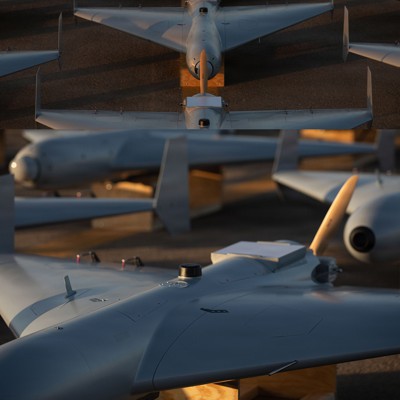
The U.S.-made LUCAS, a low-cost attack drone modeled on the Iranian Shahed-136, made its combat debut in Saturday’s strikes on Iran, and drew a wave of Shahed attacks in return.
“CENTCOM’s Task Force Scorpion Strike—for the first time in history—is using one-way attack drones in combat during Operation Epic Fury. These low-cost drones, modeled after Iran’s Shahed drones, are now delivering American-made retribution,” U.S. Central Command said in a statement.
In response to the strikes, Iran used Shaheds to strike U.S. Fifth Fleet headquarters in Bahrain, a CENTCOM official confirmed to Defense One.
“A few did get through” but caused no casualties and inflicted only “minimal damage” to the base, which remains operational, they said.
Last July, Arizona-based drone maker Spectreworks showed off the LUCAS at an event in the Pentagon courtyard, just a month before the Air Force began seeking an “exact replica” of the Iranian Shahed-136. In December, CENTCOM announced that they had deployed a “squadron” of the LUCAS drones to the region for testing and experimentation.
On Saturday, the official said that the term “squadron” did not really denote the actual number of aircraft.
“Don’t think of it as a traditional squadron; it could be 100 or 2,000,” they said.
While the LUCAS was originally developed to mimic the Shahed for training, its modular, open architecture enables it to carry a variety of payloads. In December, officials acknowledged that they were testing it for a wide variety of missions, including reconnaissance and intelligence collection, in addition to one-way attacks. On Dec. 16, a LUCAS was test-launched from the littoral combat ship Santa Barbara in the Persian Gulf.
The official would not say how many LUCAS drones were used in Operation Epic Fury, but said the strikes also included Tomahawk cruise missiles, which can also be fired from Navy warships. (Asked about reports that said 21 Tomahawks had been fired in the operation, the official said it was “way more” than that.)
Iranian stocks
The number of Shaheds that Iran can bring to bear depends on a number of factors. Its ability to manufacture the drone is limited. U.S.-led sanctions have forced the regime to turn to smuggling to obtain critical accelerometers and gyroscopes for navigation, satellite-navigation receivers, and other components.
In January, Iran’s Tasnim News Agency reported that its government had received a new batch of 1,000 drones, but those numbers are impossible to verify by Western sources.
Tehran’s stockpile also depends on how many Shaheds it has exported to Russia, its strategic ally, which has for several years used the drone heavily to strike targets in Ukraine.
A CNA report from January 2025 said Iran was “struggling to meet Russia’s demand.”
So Russia has been building up its ability to produce Shaheds under license. Last July, U.S. satellite photos showed that Russia greatly expanded its Alabuga SEZ facility and was aiming to produce 25,000 Shahed-136 drones a year, the Institute for Science and International Security noted, adding that the actual figure is likely closer to 18,540 per year.
In 2024, RUSI estimated that Russia was making the drones for $80,000 apiece.
Moscow’s willingness to build up Iranian stockpiles is unclear, but the two countries have been collaborating to improve their drones and related tactics.
“The Iranians and their Russian allies had four years of target practice on Ukrainian cities to improve their Shahed drones. And most of the world smiled politely and thought it is just the Ukrainians’ unfortunate problem,” noted Wall Street Journal chief financial correspondent Yaroslav Trofimov on X., adding, “New Shaheds are much more difficult to intercept and are very accurate.”
U.S. production
But the U.S. ability to produce the Shahed clones is also limited. While the Pentagon has expanded efforts to quickly produce large numbers of cheap one-way attack drones, they are still relatively new.
The U.S. still has conventional missiles for both targeted strikes and potential defense against drones. But these are often orders of magnitude more costly than Shaheds. Here, too, the U.S. faces constraints an a growing number of potential deployments.
“US destroyers launched Tomahawks at Iranian targets, but here’s the problem: America doesn’t have unlimited [Tomahawk Land Attack Missile, or TLAMs]. The Trump administration burned through big numbers in earlier strikes on Iran, Houthis, and Nigeria without replenishing stockpiles. TLAMs would be vital in a China fight,” Bloomberg defense analyst Becca Wasser posted on X on Saturday.
The United States might try to turn to its European allies for help, and those relationships provide a possible picture of the robot war’s next scene. The most effective defense against Shahed-136 drones is a $2,500 interceptor made by Ukraine.
Read the full article here
5 Comments
Solid analysis. Will be watching this space.
Good point. Watching closely.
Interesting update on Shahed drone meets clone in US war on Iran. Looking forward to seeing how this develops.
This is very helpful information. Appreciate the detailed analysis.
Great insights on Defense. Thanks for sharing!