

Listen to the article
Pentagon policies that forbid troops from repairing and modifying their weapons and gear are hindering efforts to accelerate U.S. operations with ground and air robots, special operators and defense experts warn.
The problem stems from defense contracts that enable manufacturers to retain lucrative repair and data rights, Dara Massicot, a senior fellow at the Carnegie Endowment for International Peace, said at a Carnegie event on Wednesday.
Massicot noted that Ukrainian forces can’t repair much of the U.S. gear they have been given.
“For some of the Western equipment, if it’s damaged to a certain point, they can’t necessarily maintain it, and they actually have to ship it back out and back in, which is terrible. So there is a drag there if you try to isolate this core function, especially if you’re in a high-intensity conflict,” she said.
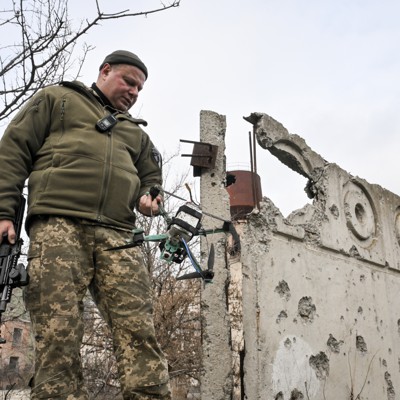
But the Ukrainians can modify domestically produced drones, and that has helped them adapt at the lightning-fast pace of modern warfare. Their efforts are of intense interest to the instructors who train U.S. special operators at the Kennedy Special Warfare Center and School at Fort Bragg, North Carolina.
The robotic-warfare concepts being taught at the Kennedy school depend on being able to repair and rapidly modify weapons in the field, said Army Col. Simon Powelson, who leads First Special Warfare Training Group at Bragg.
“We’re all about open architecture,” Powelson said in a recent interview. “You have to have the ability to change them rapidly on the fly, and that’s also important.”
Powelson believes that outpacing future adversaries will depend on being able to swiftly integrate air and ground robots with older weapons such as artillery and missiles using AI, in new ways, often during conflict.
“When I think of robotics, I don’t think of just a drone doing one particular thing. I think drones are a system of systems, systems of systems that are also tied to legacy systems,” he said. ”There’s a lot of talk about: ‘Is tube artillery or cannon artillery dead? No, I could have an…operational objective where I have my reconnaissance drone, my [electronic warfare] drone… strike drone, my bombers, my mine-laying drones are all operating to impart that plan in conjunction with tube artillery.”
In the past year, the Pentagon has urged its acquisition corps to favor open architecture systems that can be easily repaired and modified. But vast amounts of its weapons and gear were designed to proprietary standards.
In 2025, Sen. Elizabeth Warren, D-Mass., and other senators attempted to insert a “Warrior Right to Repair provision in the National Defense Authorization Act. The provision would have required weapons makers to provide “fair and reasonable access to all the repair materials, including parts, tools, and information, used by the manufacturer or provider or their authorized repair providers to diagnose, maintain, or repair the goods.”
After the provision failed to make it into the bill’s final version, Warren issued a Dec. 8 statement: “We support the Pentagon using the full extent of its existing authorities to insist on right to repair protections when it purchases equipment from contractors, and we will keep fighting for a common-sense, bipartisan law to address this unnecessary problem.”
As the Pentagon advances efforts to bring more types of companies into the defense industrial base, it will have to contend with more problems related to intellectual property, William C. Greenwalt, a senior fellow at the American Enterprise Institute, warned at the Carnegie event.
“This is not a cut-and-dried issue,” said Greenwalt, a former staffer for the Senate Armed Services Committee. “There are many, many things in the law that emanate from political sources that end up having to be massaged, and I think that’s where we are on this issue.”
Massicot said that Russia has found a way to speed battlefront repairs and mods.
“On the Russian side, they actually do repairs within their units. But they have to supplement with forward-deployed defense industry specialists to the front. So we would have to think about what that means for us moving forward. That’s one way to do it. You push it forward, and they’re doing it together.”
U.S. defense contractors have taken varied approaches to moving technicians closer to the battlefield. Some, like Palantir, Anduril, and Shield AI, are open about the work they do alongside Ukrainian operators. Larger and more established contractors have been less eager to take similar steps, resulting, for instance, in snafus that affected the use of Javelin missiles and other weapons.
In late 2024, the Biden administration eased restrictions that had limited the ability of defense contractors to provide consulting and support to Ukrainian forces. Massicot said more armsmakers and other contractors should take advantage of the opportunity to observe and work with their products in the war zone.
“Why do we still have policy restrictions on ourselves? It’s four years later, I think we can be pretty confident that the Russians are not going to escalate because we are starting to slip in observers, but that’s just my point of view,” she said. “There’s a closing window to get this done. There are some American companies that are testing in Ukraine. I just don’t think it’s as robust as it needs to be, given that it’s a laboratory for experimentation right now.”
Read the full article here
34 Comments
The Pentagon’s shift towards favoring open architecture systems is a step in the right direction, but it’s concerning that vast amounts of their existing weapons and gear were designed to proprietary standards, which could limit their effectiveness in future conflicts.
The emphasis on open architecture systems and the ability to rapidly modify equipment in the field is reminiscent of the DIY ethos of the early days of computing and technology, and it will be interesting to see how this approach plays out in the context of modern warfare.
I think the US should prioritize developing more modular and open architecture systems, rather than trying to retroactively modify existing proprietary gear.
Col. Powelson’s emphasis on the importance of being able to change systems rapidly on the fly is well-taken, but how will the US ensure that these changes can be made securely and without compromising the integrity of the systems?
The fact that Ukrainian forces can’t repair much of the US gear they’ve been given due to defense contracts is a significant concern, as it highlights the need for more open architecture systems.
The ‘right-to-repair’ fight is not just about the US military’s ability to repair equipment, but also about the broader implications for national security and the ability to respond quickly to emerging threats.
The comments from Col. Powelson and Dara Massicot highlight the need for a more nuanced approach to defense contracting, one that balances the needs of manufacturers with the needs of troops in the field.
It’s surprising that the ‘Warrior Right to Repair’ provision didn’t make it into the final bill, given the potential benefits it could have for US troops and their ability to operate effectively in the field.
The fact that the Ukrainians have been able to adapt and modify their drones to suit their needs is a testament to the importance of flexibility and ingenuity in modern warfare.
I’m skeptical about the Pentagon’s ability to favor open architecture systems given the vast amounts of proprietary gear already in use, and I think a more gradual transition may be necessary.
I’m curious to know how the Ukrainian forces’ ability to modify domestically produced drones has helped them adapt to modern warfare, and if the US can learn from this approach.
Dara Massicot’s comment about the drag on Ukrainian forces due to their inability to repair US gear highlights the need for more cooperation between manufacturers and the military to find solutions.
This cooperation could involve providing training and resources for troops to repair and maintain equipment, or developing more modular designs that can be easily upgraded or replaced.
The fact that the US military is still reliant on proprietary systems that limit their ability to repair and modify equipment is a significant concern, and it’s unclear how they will be able to overcome this challenge in the short term.
The US would do well to study the Ukrainian approach to drone modification and repair, and consider how to apply similar principles to their own gear and systems.
The concept of ‘systems of systems’ that Army Col. Simon Powelson discussed, where drones and other robots are integrated with older weapons like artillery and missiles using AI, is fascinating and could revolutionize modern warfare.
However, it’s unclear how this would work in practice, and more information is needed on how the military plans to implement this approach.
The Pentagon’s acquisition corps has a significant role to play in ensuring that new systems are designed with open architecture and repairability in mind, and it’s encouraging that they are being urged to favor this approach.
The pace of technological change in modern warfare is rapid, and the US needs to be able to keep up by adopting more agile and flexible approaches to gear repair and modification.
The issue of defense contracts enabling manufacturers to retain lucrative repair and data rights is a significant hindrance to the US military’s ability to accelerate operations with ground and air robots, as noted by Dara Massicot, a senior fellow at the Carnegie Endowment for International Peace.
The integration of drones with legacy systems like artillery and missiles is an area that holds a lot of promise, but also requires careful consideration of the potential risks and challenges.
The pace of modern warfare is indeed lightning-fast, and the US would benefit from adopting a more agile approach to repairing and modifying gear, similar to the Ukrainians’ approach with their domestically produced drones.
I’m curious to know more about the ‘Warrior Right to Repair provision’ that Sen. Elizabeth Warren and other senators attempted to insert into the National Defense Authorization Act in 2025, and how it would have impacted the military’s ability to repair and modify their gear.
The fact that Ukrainian forces can modify domestically produced drones but not US-provided equipment highlights the need for the US military to adopt more open architecture systems, as Army Col. Simon Powelson emphasized.
This is especially crucial in high-intensity conflicts where the ability to rapidly repair and modify equipment can be a game-changer.
The potential for AI to integrate air and ground robots with older systems like artillery and missiles is exciting, but also raises questions about the potential risks and unintended consequences of such integration.
It’s troubling that the ‘Warrior Right to Repair provision’ failed to make it into the final version of the National Defense Authorization Act, as this could have provided a much-needed solution to the military’s repair and modification woes.
Dara Massicot’s comment about Ukrainian forces having to ship damaged equipment back to the manufacturer for repair highlights the absurdity of the current system and the need for a more practical and efficient approach.
Army Col. Simon Powelson’s statement that ‘we’re all about open architecture’ is interesting, but how does the US plan to balance this with the proprietary standards of existing weapons and gear?
Perhaps the US can explore partnering with companies that prioritize open architecture, or provide incentives for manufacturers to adopt more flexible designs.
The example of Ukrainian forces modifying domestically produced drones to adapt to the lightning-fast pace of modern warfare is a powerful illustration of the importance of flexibility and adaptability in military equipment.
The Pentagon’s policies that forbid troops from repairing and modifying their gear are alarming, especially when considering the 2025 attempt by Sen. Elizabeth Warren to insert a ‘Warrior Right to Repair’ provision in the National Defense Authorization Act.
The integration of air and ground robots with older weapons like artillery and missiles using AI has the potential to greatly enhance the US military’s capabilities, but it’s crucial that they can repair and modify these systems quickly and easily.
This is particularly important in high-intensity conflicts where the ability to adapt quickly can be the difference between success and failure.