

Listen to the article
Nearly 200 more miles of the U.S. border with Mexico have been placed under Air Force supervision, enabling wider use of military force and heftier charges against people crossing illegally into the country. But experts wonder why the step is being taken as crossings plummet and heightened charges are thrown out by judges.
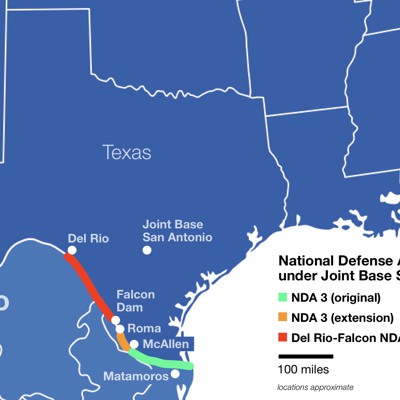
Last June, Pentagon leaders announced that they would take charge of land along the final 250 miles of the Rio Grande, which had been administered by State Department employees on the International Boundary and Water Commission. Designated National Defense Area 3, the land was placed under the control of Joint Base San Antonio, which is operated by the Air Force. As with similar zones established last year, the NDA designation effectively turned the land into a military base that can be patrolled by troops. As well, trespassers are subject to misdemeanor charges related to illegally entering Defense Department property.
On Friday, Air Force leaders announced that they have militarized two new swaths of land along the Rio Grande. One adds about 40 miles to the existing NDA 3, extending the zone upriver to Roma, Texas. The other is a 150-mile stretch from Falcon Dam to Del Rio that has been dubbed NDA 6.
A press release from the office of Air Force Secretary Troy Meink said that the moves were intended to “strengthen interagency coordination and bolster security operations along the U.S. southern border.” It said the Department of the Air Force and U.S. Northern Command “will coordinate closely to support operational requirements and ensure effective installation management” and that Joint Task Force Southern Border troops are tasked with “temporarily detaining trespassers until they are transferred to the appropriate law enforcement authorities.”
Last month, the military began launching the Seasats Lightfish, a long-endurance autonomous surface vessel, into its portion of the Rio Grande to watch for border crossings. Other assets deployed to the southern border include UH-72 Lakota helicopters, C-130 Hercules and C-17 Globemaster transports, Stryker armored vehicles, the destroyer Cole, and thousands of U.S. troops.
Since April, the Trump administration has created NDAs in Arizona, California, New Mexico, and Texas as extensions of Army, Navy, Air Force, and Marine Corps bases. By July, they covered roughly one-third of the U.S.-Mexico border.
Defense experts have questioned the expansion of the newest Air Force-controlled border zones, especially as administration officials boast that crossings have sunk to record-low levels. There were roughly 444,000 southwest border crossings by land last year, down from 2.1 million in 2024, according to U.S. Customs and Border Protection data.
“If you believe the administration’s line that there’s basically no more illegal immigration, it seems that the step is probably unnecessary. I can’t really see a rationale for doing it,” said Jennifer Kavanagh, a senior fellow and director of military analysis at the Defense Priorities think tank. “The only reason to really do it is this continuing press to militarize Trump’s foreign policy and Trump’s approach to border security.”
Since the creation of the first militarized border zones last year, dozens of cases against people accused of crossing into the NDAs were thrown out by federal judges. Some magistrates argued the government hadn’t established enough probable cause that migrants had willingly intended to cross onto Defense Department property; others criticized the placement of the warning signs.
As well, the militarization of the lands mean some communities are “effectively cut off from access to public lands,” the American Civil Liberties Union said in a September news release. The ACLU also warned that U.S. citizens may unexpectedly face federal trespassing charges as the NDAs grow.
“For immigrant communities, the stakes are especially high: crossing into an NDA now means risking federal trespassing charges in addition to immigration charges,” the ACLU said in the release. “U.S. citizens, too, may face prosecution if they enter poorly marked areas while traveling, hiking, hunting, or working near the border.”
Read the full article here
6 Comments
This is very helpful information. Appreciate the detailed analysis.
Great insights on Defense. Thanks for sharing!
Interesting update on The US military is taking control of more Texas borderland. Looking forward to seeing how this develops.
Solid analysis. Will be watching this space.
Good point. Watching closely.
I’ve been following this closely. Good to see the latest updates.