

Listen to the article
A civil lawsuit has been filed challenging the U.S. Department of the Interior’s (DOI’s) order directing a suspension to multiple large-scale offshore wind projects.
Empire Offshore Wind LLC (Empire), one of five leases currently under construction off the Atlantic coast, filed the suit in response to the DOI pausing multiple projects on Dec. 22, 2025, due to what they described as national security threats purportedly identified by the Department of Defense as referenced in classified reports.
Empire’s suit, filed Jan. 2 in the U.S. District Court for the District of Columbia, in part seeks a preliminary injunction to allow construction to remain ongoing while the litigation proceeds.
“While Empire continues to work closely with Bureau of Ocean Energy Management (BOEM) and the other relevant authorities to find a prompt resolution to the matter, the order is in Equinor’s view unlawful and threatens the progress of ongoing work with significant implications for the project,” Equinor, a multinational energy company headquartered in Stavanger, Norway, that is overseeing the project, said in a statement.
“The preliminary injunction filing is necessary to allow the project to continue as planned during this critical period of execution and avoid additional commercial and financing impacts that are likely to occur should the order remain effective,” they added.
A spokesperson for Empire referred Military.com to a press release and provided no additional comment.
The five projects currently suspended indefinitely are as follows:
- Vineyard Wind 1, off Massachusetts.
- Revolution Wind, off Connecticut and Rhode Island.
- Coastal Virginia Offshore Wind.
- Empire Wind and Sunrise Wind, projects off New York.
A DOI spokesperson declined to comment to Military.com, saying they do not remark on litigation matters.
Energy Implications
Empire Wind is being developed under contract with the New York State Energy Research and Development Authority (NYSERDA) to deliver what they describe as “a critical new, near-term source of electricity for New York, bolstering grid reliability at a time of rapidly growing demand.”
Equinor said that project completion is slated to provide enough electricity to power approximately 500,000 homes in New York.
The project is already more than 60% complete, they added, deeming it “a significant investment in U.S. energy infrastructure, jobs, and supply chains.”
Equinor, a multinational energy company headquartered in Stavanger, Norway, has reportedly invested over $4 billion USD into the project, of which $2.7 billion USD has been drawn under project financing. The gross value of Empire Wind as of Sept. 30, 2025, was roughly $3.1 billion and includes the South Brooklyn Marine Terminal.
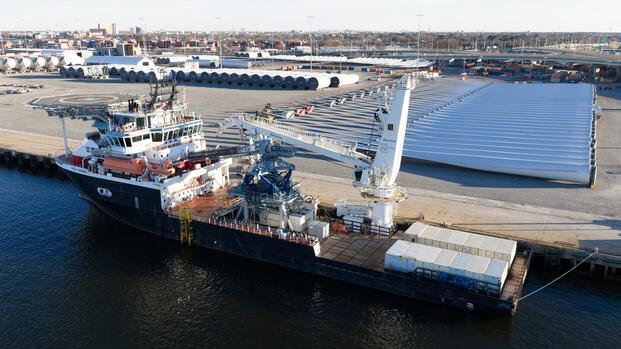
The project off the New York coast is more than 60% complete and is “a significant investment in U.S. energy infrastructure, jobs, and supply chains.”
In terms of jobs, the company said that just the project’s construction phase has employed about 4,000 people to work, both within the lease area and through the revitalization of the South Brooklyn Marine Terminal.
A NYSERDA spokesperson told Military.com that it does not comment on pending litigation.
Following the Dec. 22 work stoppage order, NYSERDA reviewed the implications for its current projects that include Sunrise Wind—which they said are already providing thousands of good-paying jobs as part of a plan to provide clean, renewable energy to more than 1 million New York homes as soon as 2027.
DoD Regulations Already Exist
The pause instituted last month was done to protect Americans’ safety, according to a statement issued by DOI Secretary Doug Burgum.
“Today’s [Dec. 22, 2025] action addresses emerging national security risks, including the rapid evolution of the relevant adversary technologies, and the vulnerabilities created by large-scale offshore wind projects with proximity near our east coast population centers,” Burgum said. “The Trump administration will always prioritize the security of the American people.”

But Empire and other industry executives said the reasoning doesn’t compute.
National Ocean Industries Association (NOIA) President Erik Milito, for example, said in a statement after the pause that the current DoD regulatory process already involves a “rigorous framework” for assessing national security implications.
That framework was assessed and passed DoD standards without issue, he added.
“The process, as required by law, provides a timely, transparent and repeatable process to evaluate potential impacts and mitigation options related to offshore energy compatibility,” Milito said. “The Department of Defense coordinates at every stage of planning, permitting, and development.”
Story Continues
Read the full article here
19 Comments
I’m skeptical about the timing of the DOI’s decision, given that the project is already 60% complete and has significant investments, and I wonder if there are other factors at play that are not being disclosed.
The Empire Wind project’s significance extends beyond New York, as it has the potential to set a precedent for other offshore wind projects along the Atlantic coast, and it’s essential to consider the broader implications of the DOI’s decision.
The DOI’s decision to suspend the projects due to national security threats raises questions about the effectiveness of the current regulatory framework and the need for more robust risk assessments and mitigation strategies.
The suspension of the five offshore wind projects, including Vineyard Wind 1 and Revolution Wind, could have a ripple effect on the entire renewable energy industry, and it’s essential to consider the long-term consequences of this decision.
The fact that the project is being developed under contract with the New York State Energy Research and Development Authority (NYSERDA) highlights the state’s commitment to renewable energy and the need for federal agencies to support these efforts.
I’m curious to know more about the role of the Bureau of Ocean Energy Management (BOEM) in the project and how they plan to work with Empire and other stakeholders to find a resolution to the suspension.
The Empire Wind project’s potential to provide a critical new source of electricity for New York highlights the need for a comprehensive energy strategy that balances national security concerns with the need for renewable energy and economic development.
I’m concerned about the potential impact of the project’s suspension on the jobs and supply chains that are dependent on it, and I hope that the lawsuit will lead to a resolution that minimizes harm to these stakeholders.
The fact that Equinor has invested over $4 billion USD into the Empire Wind project, with $2.7 billion USD already drawn under project financing, highlights the significant economic implications of the project’s suspension and the need for a prompt resolution.
The Empire Wind project’s potential to provide enough electricity to power approximately 500,000 homes in New York is a significant benefit, and it’s essential to weigh this against the potential national security threats and find a balanced solution.
The suspension of the Empire Wind project, which is already 60% complete, could have significant implications for the 500,000 New York homes that are expected to be powered by it, especially considering the rapidly growing demand for electricity in the state.
I’m concerned about the potential delay in the project, as it may lead to increased energy costs for New Yorkers.
The suspension of the Empire Wind project could have significant implications for the environment, given the potential for increased greenhouse gas emissions from alternative energy sources, and it’s essential to consider the environmental impact of the decision.
As someone who lives in New York, I’m supportive of the Empire Wind project and its potential to provide a critical new source of electricity for the state, and I hope that the lawsuit will lead to a swift resolution and the project’s continuation.
The DOI’s decision to suspend the projects without providing further comment or explanation raises questions about the transparency and accountability of the decision-making process, especially given the potential impact on the environment and the economy.
I’m curious to know more about the national security threats that the Department of Defense has identified, which led to the suspension of the offshore wind projects, and how they plan to address these concerns without hindering the project’s progress.
The fact that the gross value of Empire Wind is roughly $3.1 billion, including the South Brooklyn Marine Terminal, highlights the project’s economic significance and the need for careful consideration of the suspension’s impact on the local economy.
As a supporter of renewable energy, I’m disappointed by the DOI’s decision and hope that the lawsuit will lead to a reversal of the suspension and the project’s continuation, given its potential to contribute to a more sustainable energy mix.
I’m supportive of the lawsuit and hope that it will lead to a swift resolution and the project’s continuation, given the significant investments that have already been made and the potential benefits for New York’s energy mix.