

Listen to the article
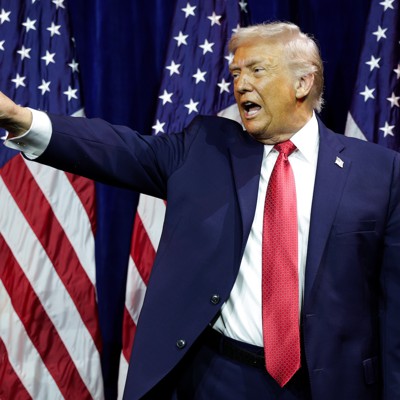
President Donald Trump wants a 50-percent boost to the Pentagon budget—to $1.5 trillion a year—and a pay cap for defense CEOs to encourage them to produce weapons faster.
In a flurry of social media posts Wednesday, the president also said he would bar defense companies from buying back stock and issuing dividends until they invest more to develop new technologies and increase production. Later on Wednesday, the White House released an executive order to that effect.
In one of his posts, Trump said “long and difficult negotiations with Senators, Congressmen, Secretaries, and other Political Representatives” led him to determine that “our Military Budget for the year 2027 should not be $1 Trillion Dollars, but rather $1.5 Trillion Dollars…I would stay at the $1 Trillion Dollar number but, because of Tariffs, and the tremendous Income that they bring…we are able to easily hit the $1.5 Trillion Dollar number while, at the same time, producing an unparalleled Military Force, and having the ability to, at the same time, pay down Debt, and likewise, pay a substantial Dividend to moderate income Patriots within our Country!”
In reality, the tariffs brought in roughly $236 billion through November—less than half of Trump’s proposed spending hike.
And far from paying down the national debt, the tariff income is dwarfed by last year’s federal budget deficit.
“The national debt has risen significantly during Trump’s first year, going from $36.2 trillion to $38.4 trillion, an increase of $2.2 trillion or nearly 6 percent”—the largest jump in recent years outside the pandemic, a recent USA Today analysis found.
In another post, Trump said, “Defense Companies are not producing our Great Military Equipment rapidly enough and, once produced, not maintaining it properly or quickly. From this moment forward, these Executives must build NEW and MODERN Production Plants, both for delivering and maintaining this important Equipment, and for building the latest Models of future Military Equipment. Until they do so, no Executive should be allowed to make in excess of $5 Million Dollars.” Also, he said, “I will not permit Dividends or Stock Buybacks for Defense Companies until such time as these problems are rectified…”
Trump had particular criticism for “Raytheon,” likely a reference to RTX. In a subsequent post, he said the company would receive no further defense contracts until it invests more in production capacity, nor be allowed to buy back its own stock “until they are able to get their act together.”
Boeing, Lockheed Martin, Northrop Grumman, and RTX did not respond to requests for comment on the president’s statements by publication. General Dynamics, HII, and L3Harris declined comment.
Trump didn’t specify how restricting buybacks or measuring research investments would be enforced.
The president’s comments touch on a longstanding tension between the government, taxpayers, and defense companies, but they also omit existing efforts like acquisition reforms.
“They’re working to change incentive structures, which is one of, really, the strongest parts about the acquisition reform,” said Jerry McGinn, director of the Center for Strategic and International Studies’ industrial base center. “You want different outcomes, you change the incentives. And that’s what they’re working to do.”
Incentives can include bigger budgets, longer-term contracts, or cheaper loans—something the Pentagon is already doing. For example, Lockheed Martin is more than tripling its annual Patriot missile production from 600 to more than 2,000 as part of a seven-year deal announced Tuesday.
The White House released an executive order to limit stock buybacks late on Wednesday.
“Effective immediately, [defense contractors] are not permitted in any way, shape, or form to pay dividends or buy back stock, until such time as they are able to produce a superior product, on time and on budget,” the order states.
In the next 30 days, the defense secretary must identify underperforming contractors “not investing their own capital into necessary production capacity, not sufficiently prioritizing United States Government contracts, or whose production speed is insufficient,” according to the executive order.
There’s also a 60-day requirement to create a provision for future contracts that ban “any stock buy-back and corporate distributions” if the contractor isn’t performing to standards set by the defense secretary.
Mark Montgomery, senior director of the Foundation for the Defense of Democracies’ Center on Cyber and Technology Innovation, said he can see “the problem the president is trying to address in the shipyards. For a number of years, some of them have maintained a ‘backlog’ of ships—ships paid for but not built or even started—and yet we instinctively order more ships each year. The yards could use this backlog to justify investments in modernizing the yards—or they could use this future revenue to justify payments such as dividends or stock buybacks. They have all too often chosen the latter.”
The second Trump administration has so far keenly focused on defense manufacturing, and specifically shipbuilding, where yearslong program delays, workforce shortages, and supply chain challenges have increased costs.
Navy Secretary John Phelan, like his predecessor, vowed to rein in costs and has pushed shipbuilders to perform and deliver on time. Phelan recently canceled the service’s frigate program, but then brought it back. The Navy also inked a deal with Palantir to install AI in shipyards to reduce costs, automate manual processes, and, ideally, build ships faster.
Montgomery, a retired rear admiral and former policy director for the Senate Armed Services Committee, said Trump’s call to restrict buybacks and dividends could be part of a broader calculus to get expensive programs, like naval ships, on track.
“A lot of problems need to be addressed to get our shipbuilding system back in order, and this action will certainly not do this alone, but it is part of an overall effort that includes more investments, partnering with successful Korean yards and more efficient design and acquisition processes,” he said.
Read the full article here
6 Comments
This is very helpful information. Appreciate the detailed analysis.
Good point. Watching closely.
Interesting update on Trump lambastes defense CEOs over pay, stock buybacks. Looking forward to seeing how this develops.
Great insights on Defense. Thanks for sharing!
Solid analysis. Will be watching this space.
I’ve been following this closely. Good to see the latest updates.