


Listen to the article
President Donald Trump has warned some of the nation’s most prominent defense contractors as part of his desire to increase the national military budget to $1.5 trillion by 2027, with the Pentagon supporting his efforts.
Trump wrote in a Truth Social post on Wednesday that his decision followed “long and difficult negotiations” with senators, congressmembers, secretaries and political representatives. If his wanted bigger budget became a reality, it would represent a drastic increase of roughly 50% after Congress recently passed a $900 billion defense bill for the 2026 fiscal year.
“I have determined that, for the Good of our Country, especially in these very troubled and dangerous times, our Military Budget for the year 2027 should not be $1 Trillion Dollars, but rather $1.5 Trillion Dollars,” Trump wrote. “This will allow us to build the ‘Dream Military’ that we have long been entitled to and, more importantly, that will keep us SAFE and SECURE, regardless of foe.”
The president also connected the defense budget to the tariffs he has employed worldwide, saying he would OK with a $1 trillion budget but sees financial promise in the “tremendous income” that he claims tariffs have generated.
“That would have been unthinkable in the past (especially just one year ago during the Sleepy Joe Biden Administration, the Worst President in the History of our Country!). … We are able to easily hit the $1.5 Trillion Dollar number while, at the same time, producing an unparalleled Military Force, and having the ability to, at the same time, pay down Debt, and likewise, pay a substantial Dividend to moderate income Patriots within our Country!” the president added.
Updated projections from the Congressional Budget Office (CBO) in November 2025 found that enacted tariffs will reduce debt, including interest, by $3 trillion through Fiscal Year 2035—down from the $4 trillion the CBO projected in August. It changed a longer-term outlook, with CBO projecting $2.5 trillion of revenue rather than $3.3 trillion.
Pentagon, Defense Contractors React
Trump’s plan for a “dream military” also includes a shortened leash on some of the United States’ biggest defense contractors.
The president challenged contractors in another Truth Social post on Wednesday, writing in part: “All United State Defense Contractors, and the Defense Industry as a whole, BEWARE: While we make the best Military Equipment in the World (No other Country is even close!), Defense Contractors are currently issuing massive Dividends to their Shareholders and massive Stock Buybacks, at the expense and detriment of investing in Plants and Equipment. This situation will no longer be allowed or tolerated!”
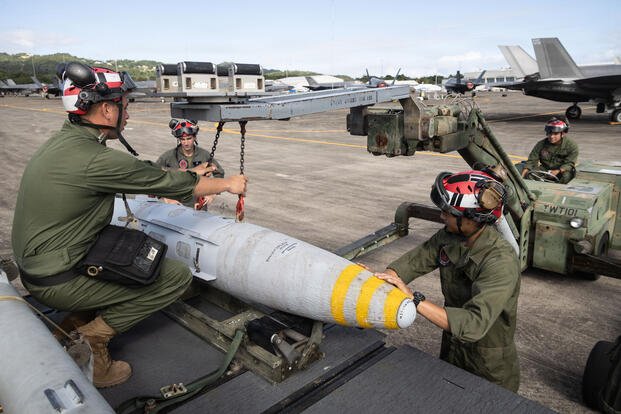
Defense contractor executives’ salaries, stock options and other forms of compensation “are far too high,” Trump added, saying that no executive should be allowed to make in excess of $5 million if they don’t deliver and maintain equipment or if they do not construct new, modern production plants.
“Defense contractors will no longer be allowed to leave our warfighters behind while giving themselves massive payouts from stock buybacks.”
“After numerous years of failing to meet contractual obligations, under President Trump’s order, defense contractors will no longer be allowed to leave our warfighters behind while giving themselves massive payouts from stock buybacks,” chief Pentagon spokesperson Sean Parnell told Military.com. “This will give [the] Department of War the ability to meet national security objectives and ensure efficiency and accountability. Our obligation is to our warfighters, not Wall Street.”
Military.com reached out to the nation’s largest defense contractors for comment, including Lockheed Martin, General Dynamics and Northrop Grumman.
“Lockheed Martin shares President Trump’s and the Department of War’s focus on speed, accountability, and results, and will continue to invest and innovate at scale to ensure our warfighters maintain a decisive advantage and are never sent into a fair fight,” a Lockheed Martin spokesperson told Military.com.
General Dynamics, when reached by Military.com, declined to comment.
Trump Targets One Major Contractor
Trump, in a separate defense contractor-related social media post, targeted one specific company—Raytheon, a business unit of RTX Corporation.
The president said he was told by the Department of Defense that Raytheon “has been the least responsive to the needs of the Department of War, the slowest in increasing their volume, and the most aggressive spending on their Shareholders rather than the needs and demands of the United States Military.”

“Raytheon seems to think this is the Biden Administration, and this is ‘business as usual,’ IT’S NOT!” Trump wrote. “Either Raytheon steps up, and starts investing in more upfront Investment like Plants and Equipment, or they will no longer be doing business with Department of War.
“Also, if Raytheon wants further business with the United States Government, under no circumstances will they be allowed to do any additional Stock Buybacks, where they have spent Tens of Billions of Dollars, until they are able to get their act together.”
Military.com reached out to Raytheon for comment.
Story Continues
Read the full article here
18 Comments
The president’s challenge to defense contractors to invest in plants and equipment rather than issuing massive dividends to shareholders and buying back stocks is a step in the right direction, as it could lead to more efficient use of resources and better outcomes for the military.
The National Security Strategy released in November 2025 must have played a significant role in shaping the president’s decision to increase the defense budget, and I’d like to know more about the specific recommendations and guidelines outlined in the strategy.
The emphasis on building a ‘Dream Military’ that can keep the country ‘SAFE and SECURE’ is a laudable goal, but it’s essential to consider the potential risks and unintended consequences of such a significant increase in military spending.
The connection between the defense budget and the tariffs is complex, and I’d like to see a more detailed analysis of how these two issues are related and what the potential outcomes will be for the country’s economy and security.
The role of the Congressional Budget Office in evaluating the potential impact of the tariffs and defense budget on the national debt is crucial, and their projections should be carefully considered in the decision-making process.
As a taxpayer, I’m interested in knowing more about how the increased defense budget will be funded and what the potential consequences will be for the national debt and the overall economy.
The president’s use of social media to announce and explain his defense budget plans is an unconventional approach, and I’m curious to see how this will impact the public’s perception and understanding of the issue.
I’m concerned that the focus on defense spending may divert attention and resources away from other critical areas, such as diplomacy and international cooperation, which are essential for maintaining global stability and security.
The $1.5 trillion defense budget is a significant investment in the country’s military capabilities, and it’s essential to ensure that the funds are being used efficiently and effectively to achieve the desired outcomes.
The reaction from defense contractors to the president’s challenge will be crucial in determining the success of the plan, and I’m curious to see how they will respond to the new expectations and guidelines.
The 50% increase in the defense budget is a drastic measure, and I’m concerned about the potential impact on other areas of the federal budget, such as education and healthcare, which may see significant cuts as a result.
As someone who has worked in the defense industry, I can attest that the current system is in need of reform, and the president’s plan to hold contractors accountable for their investments is a positive step towards creating a more efficient and effective military.
The proposed $1.5 trillion defense budget for 2027 is a significant increase from the $900 billion defense bill passed for the 2026 fiscal year, and I’m curious to know how the administration plans to allocate these funds to build the ‘Dream Military’ that Trump mentioned.
It’s likely that a large portion of the funds will go towards modernizing the military’s equipment and technology, as well as increasing the number of personnel.
I’m intrigued by the idea of paying a ‘substantial Dividend to moderate income Patriots’ within the country, and I’d like to know more about how this would work and who would be eligible to receive such a dividend.
I’m skeptical about the claim that the tariffs will generate ‘tremendous income’ and help reduce debt by $3 trillion through Fiscal Year 2035, as the Congressional Budget Office’s projections have been adjusted downwards from $4 trillion to $3 trillion.
The comparison between the Trump administration’s defense budget and the ‘Sleepy Joe Biden Administration’ is unfair, as each administration has its own unique challenges and priorities, and it’s essential to evaluate the budget based on its own merits rather than making partisan comparisons.
I agree with the president’s statement that the current situation with defense contractors issuing massive dividends and stock buybacks ‘will no longer be allowed or tolerated’, as it’s essential to prioritize the needs of the military and the country over corporate profits.