

Listen to the article
The removal of two memorial displays at an American cemetery in the Netherlands honoring Black veterans who helped liberate Europe from Nazi rule has drawn the ire of many.
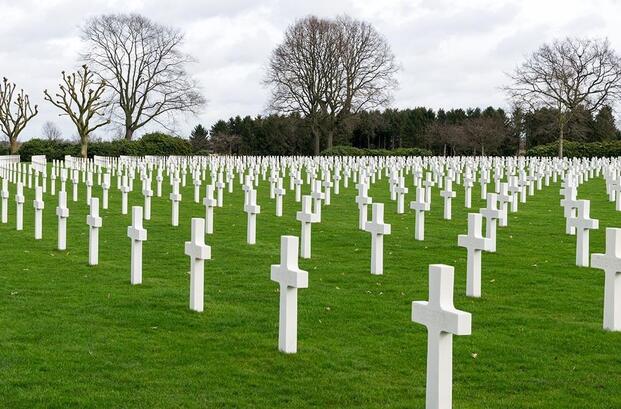
Last spring, the American Battle Monuments Commission, which manages memorial sites outside U.S. soil, took down the panels from the visitors’ center at the cemetery in Margraten where nearly 8,300 American troops are buried.
Removing the panels comes after President Donald Trump signed several executive orders eliminating diversity, equity, and inclusion initiatives throughout government agencies. That also meant removing a memorial to Black soldiers.
According to CBS News, the removal occurred with no explanation to the public. The move mystified government officials in the Netherlands, families of American troops, and Margraten residents who donate time caring for the graves.
Joe Popolo, U.S. Ambassador to the Netherlands, visited the cemetery after the panel removal sparked controversy. He wrote on social media that, “The signs at Margraten are not intended to promote an agenda that criticizes America.” The ambassador declined to comment further on the subject with CBS News.
What angers supporters of the panels the most is that the memorials represented a part of American history, no matter what Popolo contends.
One panel featured George H. Pruitt’s story. Pruit, a 23-year-old Black soldier, is buried at Margraten. In 1945, Pruitt died trying to save a fellow soldier from drowning. The other display informed the public of America’s racial segregation policies during World War II.
More than 1 million Black men joined the service in World War II. Despite answering the call to defend freedom, they served in segregated units and were often assigned menial work. However, many did serve in dangerous combat missions.
In fact, the huge cemetery in Margraten would not exist without the work of an all-Black unit tasked with digging thousands of graves for soldiers amid the infamous winter of 1944-45.
Panels Important for Many
Cor Linssen is one of the local residents protesting the removal of the panels. Linssen, 79, is the son of a Black U.S. veteran and a Dutch mother who was raised about 30 miles from the cemetery. While he didn’t get to know his father until later in life, he came to realize he was the son of a Black soldier.
“When I was born, the nurse thought something was wrong with me because I was the wrong color,” he told The Associated Press. “I was the only dark child at school.”
Linssen visited the cemetery in February, before the panels were removed, with a group of other children of Black American soldiers. All in their 70s and 80s, the memorials held a special place in their hearts, representing the sacrifice of their fathers.
“It’s an important part of history,” Linssen said. “They should put the panels back.”
Mystery Surrounding Removal
The panels were apparently removed in secrecy, and for months, questions lingered. Two news outlets, the Dutch News and the Jewish Telegraphic Agency (JTA), recently published emails obtained from Freedom of Information Act requests clearly noting that the panels were taken down following the Trump administration’s DEI overhaul.
The AP did not receive a response from the White House about the panel controversy, and the American Battle Monuments Commission stated to the AP that the panel telling the story of segregation “did not fall within (the) commemorative mission.”
The commission also claimed the Pruitt memorial was “rotated” out, being replaced by a panel featuring white veteran Leslie Loveland, who was killed in 1945 in Germany and is buried at the cemetery.

“Something Has Changed”
The panels were not up for very long, having been placed in 2024.
Theo Bovens, Chair of the Black Liberators foundation told CBS News his organization advocated for the panels to be placed at the visitors’ center. Bovens, a Dutch senator, said he was never told the memorials would be removed.
“It’s strange that the U.S. commission feels the panels are not in their mission, as they placed them in 2024,” Bovens told the AP. “Something has changed in the United States.”
Bovens is among the thousands of residents who care for the Margraten graves. Locals can adopt a grave, clean the headstone, and leave flowers for the deceased soldier on their birthdays, Memorial Day, and Veterans’ Day. Once a family adopts a grave, maintenance of the soldier’s final resting place is passed on for generations. The Netherlands even has a wait list for those hoping to adopt a grave.
Officials in both Margraten and its province have demanded that the panels be brought back to the cemetery. In November, a Dutch TV show went so far as to recreate the panels, placing them outside the cemetery. Police took them down almost immediately, but the program hopes to find a permanent place for the panels.
If the panels at the military cemetery are not returned, the Black Liberators said they plan to seek another location to honor Black soldiers who sacrificed their lives to free the Dutch from Nazi oppression.
Writing Out History
Outside the Eijsden-Margraten city hall is a place called America Square, featuring a small park named after Jefferson Wiggins, one of the many Black soldiers who dug the final resting spots for soldiers at the cemetery.
Wiggins wrote in his memoir, published following his death, the feeling he had about burying the bodies of fellow white soldiers he wasn’t allowed to develop relationships with during the war.
But people in the Netherlands had a different approach to Black soldiers in World War II, treating them as the heroes that they were, according to author Linda Hervieux, who wrote “Forgotten,” a book sharing the stories of Black servicemen who, despite fighting on D-Day, still had to face segregation back home.
The removal of the panels concerns Hervieux, as it “follows a historical pattern of writing out the stories of men and women of color in the United States.”
Story Continues
Read the full article here
6 Comments
Great insights on Defense. Thanks for sharing!
I’ve been following this closely. Good to see the latest updates.
Good point. Watching closely.
Solid analysis. Will be watching this space.
This is very helpful information. Appreciate the detailed analysis.
Interesting update on US Removal of Panels Honoring Black WWII Soldiers Buried in Netherlands Sparks Anger. Looking forward to seeing how this develops.