

Listen to the article
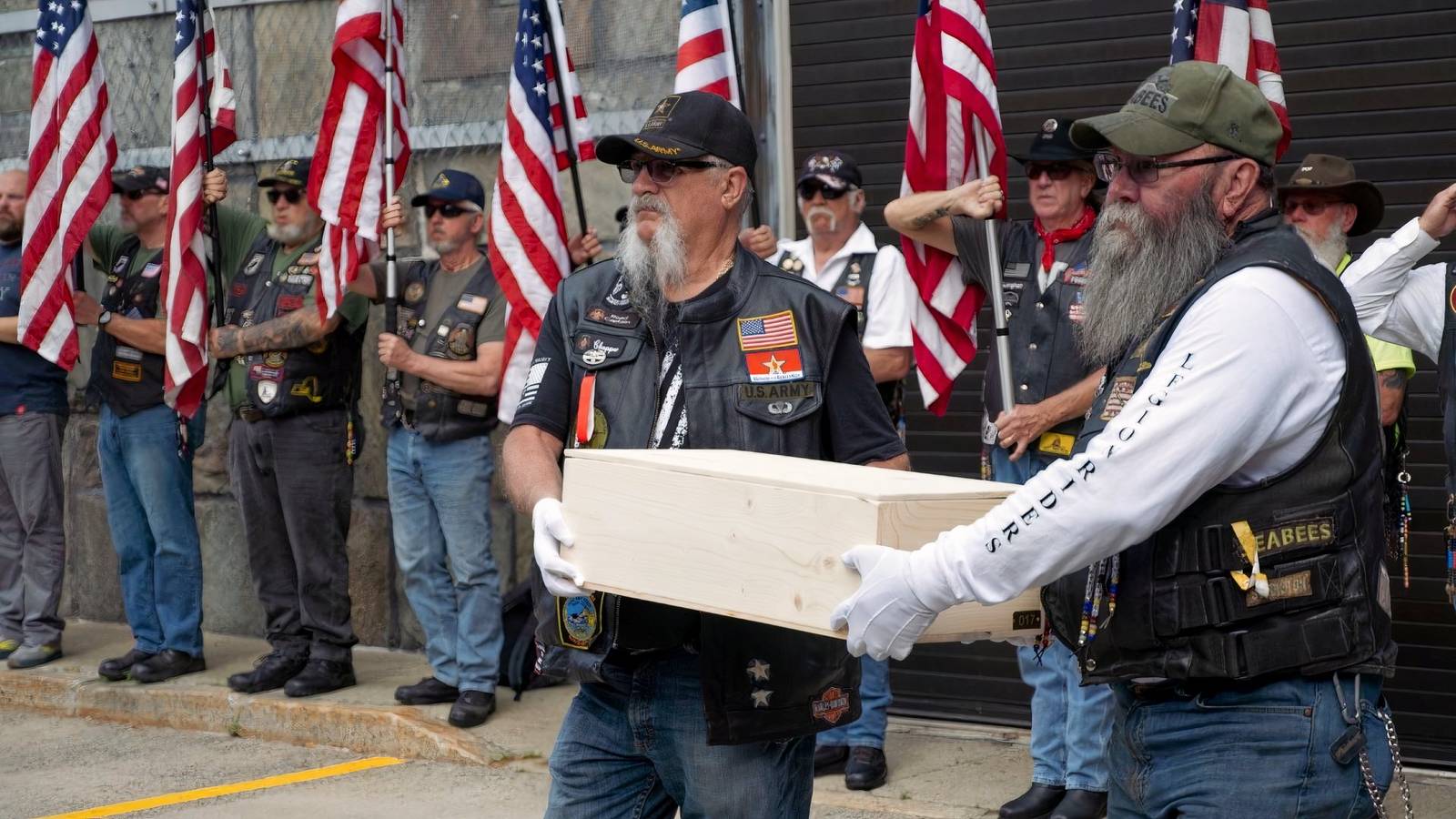
The remains of 44 people believed to have been associated with the Continental Army were interred Wednesday at a new memorial in Lake George Battlefield State Park in upstate New York, 250 years after they likely died of smallpox at a military hospital on the southern shore of Lake George.
A motorcade of nine Korean War and Vietnam-era military trucks reportedly carried the 44 wooden caskets 60 miles north from the New York State Museum in Albany to the park along Route 9 on May 20. Members of the NY-Penn Military Vehicle Collectors Club operated the trucks, with New York State Police leading the procession and Patriot Guard Riders providing a motorcycle escort.
Four of the lead caskets were draped in flags, three with the Grand Union Flag, and a fourth had the flag of the 1st Pennsylvania Battalion—the only unit positively linked to the burial site through artifacts recovered with the remains.
Construction workers digging an apartment building foundation on Courtland Street in the village of Lake George in February 2019 uncovered the remains. By the time the crew reported the discovery to the Warren County Sheriff’s Office, they had already relocated roughly 70 dump truck piles of soil from the site.
‘Bits and Pieces’
Beneath the disturbed ground in the Lake George village was an 18th-century cemetery. Graves had already been badly disrupted by the excavation.
“We weren’t able to properly recover complete individuals. It was pieces, bits and pieces of people,” Lisa Anderson, curator of bioarcheology at the New York State Museum, told Spectrum News, which has reach throughout Central and upstate New York.
Anderson supervised the recovery alongside Charles “Chuck” Vandrei Jr., the Department of Environmental Conservation’s (DEC) preservation officer, who championed the re-interment effort before his death. More than 100 volunteers worked with museum and DEC archaeologists over the course of 15 months, sifting through excavated soil to recover bone fragments and artifacts.
Julie Weatherwax, a bioarcheology technician at the state museum, spent nearly a year reassembling more than 800 loose teeth into individual dental records to establish the minimum number of remains buried at the site, according to WRGB, the local CBS affiliate in Albany.
Most of the caskets were placed directly into the memorial upon arrival on Wednesday, while four were taken to a nearby church for safekeeping ahead of a public dedication ceremony scheduled for May 22.
The memorial, called “Repose of the Fallen,” sits on a knoll along Fort George Road in the park. The project cost nearly $700,000, paid for with a New York State Downtown Revitalization Initiative grant and private donations. The design includes secured columbaria, a seating area, interpretive signage and a memorial plaza.
Karl Remmers, president of the NY-Penn Military Vehicle Collectors Club, called it “an extremely high honor to transport the remains of 44 Revolutionary War soldiers.”
The Quebec Campaign and the Fort George Hospital
The soldiers are believed to have died during one of the earliest and most costly operations of the American Revolution.
In the fall of 1775, roughly 10,000 Continental Army troops from six colonies launched the Quebec Campaign, an invasion of British-held Canada aimed at seizing Montreal and Quebec City.
The 1st Pennsylvania Battalion was among them. Raised in Philadelphia in late 1775 under Col. Philip De Haas, the battalion marched north with roughly 500 men to reinforce Col. Benedict Arnold in Canada.

An assault on Quebec City on Dec. 31, 1775, ended in defeat. By early 1776, a smallpox epidemic was ravaging the retreating army.
Soldiers too sick to march were transported by boat to the southern end of Lake George, where the Continental Army had established a hospital at Fort George.
Several thousand sick and wounded passed through that hospital. Up to 1,000 of them died and were buried in unmarked cemeteries in and around what is now the village of Lake George. The 44 individuals found on Courtland Street account for only a small portion of those losses.
Reconstructing Young Soldiers
Anderson told the Town of Lake George that most of the dead were young, “in their teens and twenties, indicative of military aged persons.”
Forensic artist Jenny Kenyon produced a facial reconstruction of one soldier, depicting a teenager, using 3D-printed scans of a recovered skull. She worked with faculty at the Rensselaer Polytechnic Institute, according to the New York State Museum.
Anderson also identified two children, ages 6 and 10, among the remains. Families sometimes accompanied soldiers during the war and their presence among the dead was not unexpected, she said at a 2024 ceremony, according to the Lake George Examiner.
Uniform buttons recovered from one of the partially disturbed graves bore the insignia of the 1st Pennsylvania Battalion, confirming that at least one of the dead had served with the unit during the revolution.
The discovery also helped spur the New York Unmarked Burial Site Protection Act, signed into law in 2023, which requires anyone who finds human remains during ground disturbance to stop work and report the discovery, with criminal penalties for noncompliance.
The memorial’s formal dedication is scheduled for 11 a.m. on May 22 at Lake George Battlefield State Park, just ahead of Memorial Day.
Read the full article here
6 Comments
This is very helpful information. Appreciate the detailed analysis.
Great insights on Defense. Thanks for sharing!
Interesting update on 44 Revolutionary War Soldiers Finally Laid to Rest After 250 Years. Looking forward to seeing how this develops.
I’ve been following this closely. Good to see the latest updates.
Solid analysis. Will be watching this space.
Good point. Watching closely.