

Listen to the article
General Atomics’ has paused all flight tests and opened an investigation after one of its drone wingmen crashed Monday after takeoff, the company said in a news release.
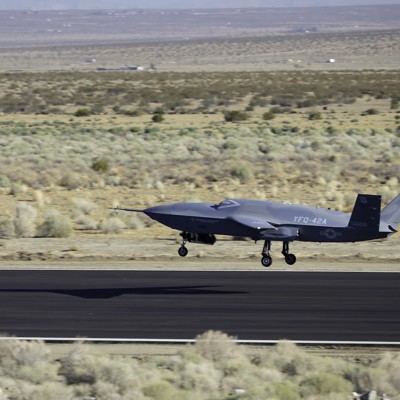
One of General Atomics’ YFQ-42A “Dark Merlin” Collaborative Combat Aircraft “experienced a mishap” at its company-owned airport in California around 1 p.m. local time, the news release said. No one was injured in the incident. Flight testing will resume when it is “deemed appropriate,” the company added, providing no timeline.
“Flight test operations have been paused temporarily in an abundance of caution,” the news release said. “As with any program, we follow a disciplined investigation process to understand exactly what occurred, and our focus right now is on gathering data and ensuring we learn from this event.”
General Atomics is competing against Anduril and Northrop Grumman in the Air Force’s collaborative combat aircraft competition. The incident with the drone wingman comes as the service prepares to award an Increment 1 production decision in the next six months. The Defense Department is seeking nearly $1 billion to buy the Air Force’s first CCAs, the 2027 budget documents released on Friday show.
The YFQ-42A involved in the crash was one of several production-representative CCAs being made for the Air Force, the company said.
“Safety is our top priority, for our people and the public. In this case, established procedures and safeguards worked as intended, and there were no injuries,” said C. Mark Brinkley, a company spokesman. “We’re going to take a close look at what happened, gather all the data, and allow the investigation to guide us moving forward.”
The Air Force is “aware of the incident and will follow all standard aircraft mishap protocols,” a service spokesperson said in an emailed statement.
An Anduril spokesperson said “all of our airplanes are fine.” A Northrop Grumman spokesperson did not immediately return a request for comment.
Anduril, General Atomics, and Northrop have all rapidly been developing their own CCA offerings in hopes of winning the Air Force’s contract.
Last month, Northrop Grumman announced it successfully tested Shield AI’s Hivemind software on its YFQ-48A Talon Blue CCA.
In February, Anduril started armed flight testing with its CCA. That same month, the Air Force validated its government-owned Autonomy Government Reference Architecture to use RTX Collins software aboard General Atomics’ YFQ-42 CCA aircraft and Shield AI’s Hivemind onboard Anduril’s YFQ-44 CCA. Anduril also completed its first semi-autonomous flight and was able to switch between Shield AI and its own mission autonomy software suites mid-air.
Rebecca Wasser, the defense lead at Bloomberg Economics, said it was “commendable” of General Atomics to stop flight tests for security and safety reasons. She added that the incident is unlikely to have a major effect on the competition, especially given Defense Secretary Pete Hegseth’s reforms to the military’s testing and evaluation ecosystem.
“I don’t think it changes the nature of the competition and gives an edge to any of the potential CCAs moving forward, Wasser said. “I think the fact that the Department of Defense has relaxed some of its operational testing and evaluation standards at the direction of the secretary, speaks to the fact that I don’t think that there’s going to be any blowback from the Pentagon about this.”
Read the full article here
12 Comments
The Air Force’s validation of its government-owned Autonomy Government Reference Architecture to use RTX Collins software aboard General Atomics’ YFQ-42 CCA aircraft is a crucial step forward, and I’m eager to learn more about the implications of this development.
I’m curious to know how this incident will impact the Air Force’s collaborative combat aircraft competition, especially with the service preparing to award an Increment 1 production decision in the next six months.
Defense Secretary Pete Hegseth’s reforms to the military’s testing and evaluation process may help mitigate the impact of this incident, but it’s essential to ensure that safety and security remain the top priorities.
Given that no one was injured in the incident, it’s clear that the established procedures and safeguards worked as intended, which is a positive note in an otherwise concerning situation.
The pause in flight tests by General Atomics after the crash of its YFQ-42A drone wingman is a prudent move, given the company’s emphasis on safety as its top priority, as stated by C. Mark Brinkley.
Rebecca Wasser’s comment that the incident is unlikely to have a major effect on the competition is reassuring, but I still have concerns about how this will affect the overall timeline and budget of the program.
I’m skeptical about the lack of a timeline for resuming flight tests, and I hope General Atomics will provide more information soon to alleviate concerns about the program’s progress.
The successful testing of Shield AI’s Hivemind software on Northrop Grumman’s YFQ-48A Talon Blue CCA last month is a notable development, and I wonder how this will influence the competition.
Anduril’s armed flight testing with its CCA in February is also a significant milestone, and it will be interesting to see how these advancements impact the final decision.
The fact that Anduril has completed its first semi-autonomous flight and can switch between Shield AI and its own mission autonomy software suites mid-air is an impressive achievement, and I’m excited to see how this technology will evolve.
The fact that the Defense Department is seeking nearly $1 billion to buy the Air Force’s first CCAs, as shown in the 2027 budget documents, highlights the significance of this project and the need for rigorous testing and evaluation.
This investment underscores the importance of getting the CCA program right, and General Atomics’ decision to pause flight tests is a step in the right direction.