

Listen to the article
An unmanned helicopter concept being developed by Airbus for Marine Corps logistics missions may pave the way for an armed variant, company officials say.
Airbus is working on an unmanned version of the MQ-72C Lakota for the Marines’ Aerial Logistics Connector competition; on Wednesday, the company said it had completed another autonomous flight test using its H145 helicopter and technology from Shield AI, L3Harris Technologies, and Parry Labs.
Company officials said it’s possible that the Lakota could be armed.
“Based on our discussions with other potential customers and partners, we believe there is an opportunity for mission expansion to include launched effects,” an Airbus official said. “Our primary focus remains providing the best aerial logistics platform for the Marine Corps. We believe the MQ-72C Lakota Connector can support a range of future missions thanks to its versatile design, [modular open system] architecture, and autonomous mission capabilities.”
Airbus is among several defense companies working on autonomous aircraft intended to replace military aviators on logistics missions. Last year, Sikorsky unveiled a pilotless UH-60L Black Hawk to carry cargo into combat zones. Similarly, Boeing announced a concept for a tiltrotor drone-wingman concept to support the Army’s helicopter fleet.
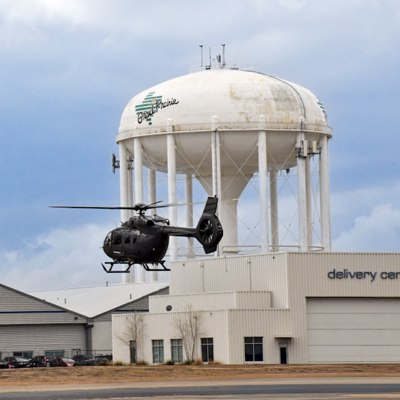
Airbus’ latest test flights, conducted in recent weeks at its Grand Prairie, Texas, facility, refined the helicopter’s perception, officials said. The H145, the commercial variant of the Lakota, scanned a landing zone in flight, detected obstacles, and found an alternative spot to land if necessary. The technology detected objects “ranging from the size of a SUV down to a pelican case,” an Airbus official said.
“This test was vital for us to show the Lakota Connector’s development in performing aerial logistics missions for the U.S. Marine Corps,” said Rob Geckle, CEO of Airbus U.S. Space and Defense. “Perception systems can make or break the success of an unmanned mission in the field, and I am excited to see our aircraft perform so well under uncertain conditions.”
Part of the effort’s fourth series of tests, the flights were conducted in recent weeks at the Airbus facility in Grand Prairie, Texas. Shield AI contributed its Hivemind autonomy software, L3 Harris supplied modular and digital backbone, and Parry Lab provided edge-computing and ground-control stations for the tests, an official said.
“This H145 flight test proves Hivemind delivers scalable autonomy across rotary and fixed-wing aircraft without custom redesign,” said Christian Gutierrez, vice president of Hivemind Solutions at Shield AI. “That speed and flexibility are critical in contested logistics.”
An Airbus official said “the next step is progressively improving perception to detect smaller, more operationally representative objects” and additional internal autonomy and integration flight tests are expected throughout the year.
The Aerial Connector program is one of several Defense Department initiatives “aimed at delivering logistical support in distributed environments during peer or near- peer conflicts,” Airbus said in the news release. Other competitors in the program include
Those developments have made some aviators fearing for their careers, Defense One previously reported, especially as the push for autonomous choppers comes as some services shed helicopter units.
Read the full article here
6 Comments
Interesting update on Airbus’ autonomous supply-helicopter effort may pave the way for an armed model. Looking forward to seeing how this develops.
I’ve been following this closely. Good to see the latest updates.
This is very helpful information. Appreciate the detailed analysis.
Solid analysis. Will be watching this space.
Good point. Watching closely.
Great insights on Defense. Thanks for sharing!