

Listen to the article
Tiberius Aerospace has entered into a Cooperative Research and Development Agreement (CRADA) with the U.S. Army Combat Capabilities Development Command Armaments Center to advance Sceptre, its liquid-fueled, ramjet-powered 155mm precision-guided artillery round.
The agreement establishes a formal framework for Tiberius and the DEVCOM Armaments Center to conduct mutually agreed research and technical work related to Sceptre. The Army uses CRADAs to collaborate with private companies on research and development, but the agreements are not procurement contracts.
Sceptre is designed to fire from existing NATO-standard howitzers without requiring a new launcher or firing platform. Tiberius says the round is intended to travel as far as 150 kilometers, accelerate beyond Mach 3, climb above 65,000 feet, and strike within 5 meters of a target—including in environments where GPS signals are unavailable or disrupted.
The Army agreement provides a new research framework as Tiberius works to mature the propulsion, guidance and software technologies required to achieve them.
From Ramjet Demonstration to Army Research
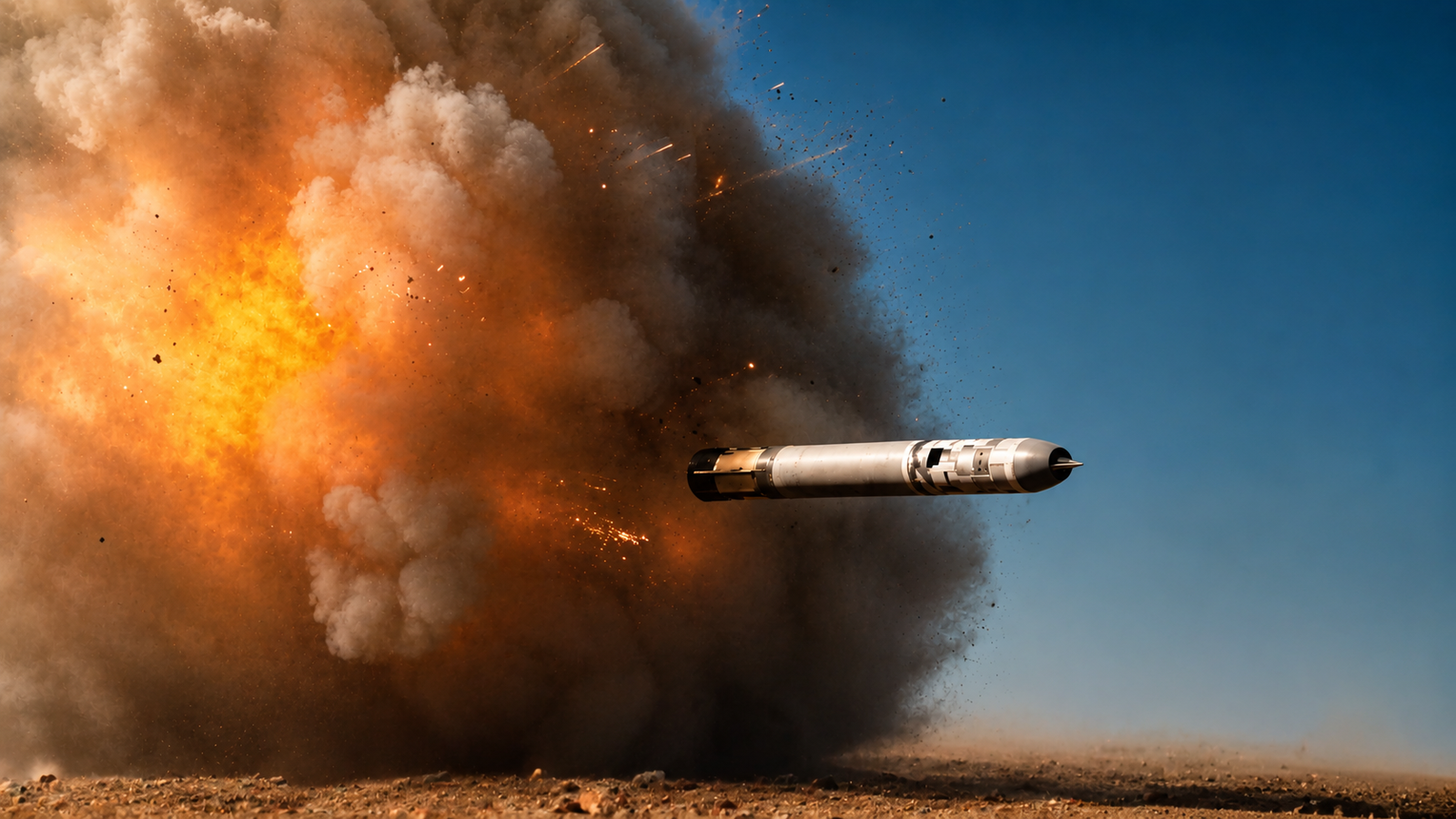
In April 2026, Tiberius fired Sceptre from a NATO-standard 155mm howitzer during testing in New Mexico and achieved liquid-fueled ramjet ignition.
The company also reported that the round remained intact under launch forces of approximately 16,000 times the force of gravity, successfully deployed its fins and maintained stable aerodynamic flight.
One obstacle is finding a facility large enough to test the round at its intended range and altitude. Conventional artillery ranges generally are not designed to accommodate a howitzer-fired projectile traveling distances associated with missiles.
“There are no gun ranges in the United States or anywhere in the world that we can actually shoot a howitzer that goes further than 40 kilometers,” Tiberius founder and CEO Chad Steelberg told Military.com.
Steelberg said Tiberius has considered testing in Jordan and is working toward access to expanded U.S. facilities where a howitzer could operate on a missile-scale range.
The company conducts live-fire tests approximately every 30 days and is integrating its guidance system, he said.
The Army Agreement Supports a Larger Production Strategy
For Steelberg, the DEVCOM agreement is not only a step toward validating one artillery round. It also supports Tiberius’ broader effort to change how allied countries develop, update and manufacture weapons.
NATO’s defense-spending surge has moved the alliance from debating budgets to confronting a more difficult problem: production. At the July summit in Ankara, allies announced more than $50 billion in new procurements after European members and Canada increased core defense investment by more than $139 billion since the 2025 summit.
The Alliance also launched the NATO Engine, a network intended to connect defense companies with available manufacturing capacity across allied countries.
The war in Ukraine has shown how quickly ammunition inventories can decline and how difficult it is to expand production after a conflict begins. The Pentagon has sought to increase 155mm artillery production; however, factories, energetic materials, specialized components and skilled workers cannot be added immediately.
“Increased spending doesn’t mean you have the pipeline of talent and skills to pivot into that industry,” Steelberg said, adding that money alone cannot rebuild depleted arsenals.
A Silicon Valley Founder Turns to Defense
Steelberg entered defense after building companies in advertising technology and artificial intelligence.

His previous companies included AdForce, dMarc Broadcasting and Veritone, where he served as CEO and chair. He left Veritone’s CEO position at the end of 2022 and resigned from its board in March 2025 while continuing as an adviser.
Steelberg shifted his focus to defense in late 2023 after Russia’s full-scale invasion of Ukraine.
“The real mission that we’re under is how do we actually change defense so that we don’t all end up losing the next war?” Steelberg said.
The Apple Model for Munitions
Tiberius calls its approach “Defense-as-a-Service.”
Traditional prime contractors generally design, qualify and manufacture a weapon through controlled production lines. Tiberius instead plans to retain and update the design while licensing approved governments or companies to manufacture it to them locally. The company argues that this would let allied nations establish sovereign production without separately paying to develop the same weapon.
“It’s not that we’re outsourcing from a cost standpoint,” Steelberg said. “We are outsourcing because we’re trying to build a network of defense suppliers and manufacturers that creates resiliency and independence.”
That model parallels the industrial problem NATO is trying to address. NATO says no single ally has enough capacity to meet demand, particularly for air defense and strike systems. Its NATO Engine will match companies that need production capacity with military and civilian factories that can provide it.
Commercial agreements, regulatory compliance and export licensing will remain the responsibility of participating businesses.

Tiberius’ GRAIL software would manage its network. The company says the platform can track suppliers, manufacturing, testing, export controls and intellectual property while comparing weapons by cost and probability of destroying a target.
Its measurements include the total cost required to destroy a target with 95% probability and the human and logistical burden associated with a weapon.
Steelberg said GRAIL traces components through multiple supplier tiers to raw materials and records individual parts through serial numbers and digital “fingerprints.”
Tiberius also plans to station manufacturing, quality-control and testing engineers inside licensed facilities and periodically test production rounds to verify compliance.
Sceptre’s Technical Bet
A conventional artillery projectile begins losing speed after leaving the barrel. A ramjet uses the projectile’s forward motion to compress incoming air, mix it with fuel and generate continuing thrust.
Steelberg said Sceptre uses the howitzer’s launch velocity to start the ramjet. Pressurized air then squeezes liquid fuel from an internal bladder, eliminating the need for a mechanical fuel pump that would have to survive the extreme force of launch.
The engine is designed to run on diesel and common military and civilian aviation fuels, including Jet A and several JP-series fuels. That flexibility allows forces to draw from fuel already available in theater rather than create a separate supply chain for specialized propellant.
Tiberius positions Sceptre as a precision weapon for tanks, fuel depots, rail infrastructure and other high-value targets—rather than a substitute for conventional artillery barrages.
“Think of this as the sniper rifle inside the kit,” Steelberg said.
In September 2025, Tiberius announced that the British Ministry of Defense had awarded it a contract for Sceptre development and rapid trials. The company said the ministry would serve as Sceptre’s launch customer and that the U.S. Defense Innovation Unit was facilitating independent verification and validation.
The Army agreement adds another government research relationship, but Sceptre’s decisive tests remain ahead.
Tiberius must complete a full-range guided flight, independently verify its accuracy and GPS-denied navigation, and demonstrate that several licensed manufacturers can produce the round consistently at the cost and volume the company projects.
Read the full article here
6 Comments
I’ve been following this closely. Good to see the latest updates.
Interesting update on Army, Aerospace Company Advance 150-Kilometer, 65,000-Foot-High Ramjet Artillery Round. Looking forward to seeing how this develops.
Great insights on Defense. Thanks for sharing!
Solid analysis. Will be watching this space.
This is very helpful information. Appreciate the detailed analysis.
Good point. Watching closely.