

Listen to the article
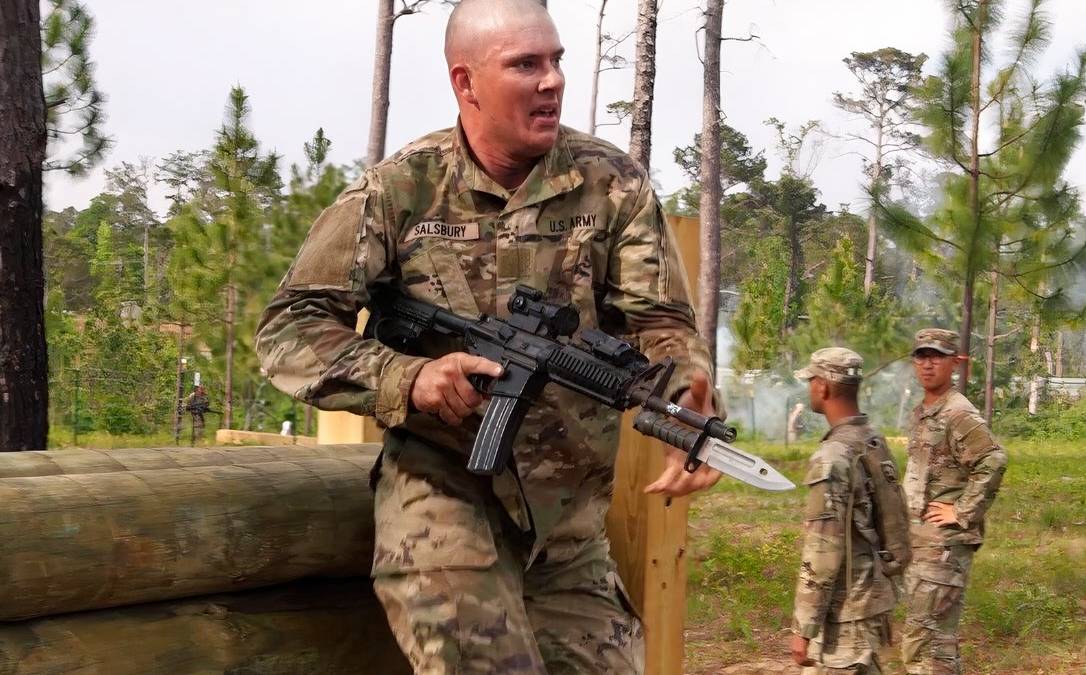
The U.S. Army’s notoriously difficult Ranger School has added a new tool during its training course. Ranger Class 06-26 recently became the first to undergo training with bayonets, a knife or blade attached to the muzzle of a rifle, as another weapon for use in face-to-face combat.
“The Bayonet Assault Course allows us to introduce a level of grit, a level of violence of action, very rapidly,” said Command Sgt. Maj. Patrick Hartung, the senior enlisted soldier at the brigade that runs Ranger School, in a video released by the Army and reviewed by Military.com.
The term bayonet is named after the French city of Bayonne. According to the Dictionary of World Origins, bayonets allow a firearm to double as a spear. Bayonets were supposedly first used by Basques in the 17th century, and continuing into the early 20th century, where they were used as an infantry melee weapon, usually when soldiers charge at another group in a mass formation, also known as a human wave attack.
In contemporary times, bayonets are considered a primitive weapon of last resort and are rarely used in combat. Instead, they are displayed for non-combat purposes, such as during military parades and in museums.
But during ranger training, soldiers are expected to become skilled at handling bayonets for minimalist reasons.
If all technology fails, (Ranger students) will have the fundamentals, said Hartung, the command sergeant major of the Airborne and Ranger Training Brigade. This is why we have them navigate terrain, close with and destroy the enemy with a bayonet.
Bayonet Training Course Simulates Face-to-Face Combat
Located at Fort Benning, Georgia, the Army’s Ranger Training School’s new bayonet course stretches a quarter-mile, where students crawl through tunnels, sprint over open fields, and scale barbed wire fences. Along the way, students are expected to use their bayonets to stab into silicone torsos designed to mimic a human enemy.
“The process of bayonet targets includes the design of the targetry,” said William Walker, lead contractor of the Fort Benning Training Support Center, in the Army training video, viewed by Military.com. “Mixing and pouring of the targets, the cutting of the metal, the welding and then the putting together of the targets.”

Once the targets are set up on a makeshift battlefield, instructors say it’s the students’ turn to show off their physical and mental toughness in the face of an enemy up close, all while navigating difficult terrain.
Organizers say so far, the bayonet training has been a success.
Never seen something come together so fast and come together so well in all my time here at Fort Benning, said Sgt. Maj. Hartung. Really an excellent job by the team.
Bayonet Training Includes International Instruction
Other segments of the Armed Forces also include some bayonet instruction. For example, the Marine Corps continues to train with bayonets during boot camp exercises as a way to foster a combat mindset. Also, Army Basic Combat Training at Fort Benning has a day of bayonet familiarization. However, the Ranger School’s online student information claims no other program offers the same level of specialized instruction.
Video of April’s first class with bayonets shows students running through a series of obstacles during the course’s initial assessment phase. Quickly, they moved to the “Darby Phase,” where they were drilled on ambush tactics, demolitions, and graded patrols.

Less than half the class proceeded to the next phase, known as the Mountain Phase, which takes place in the more rugged northern part of Georgia. Finally, the Swamp Phase in Florida tests a student’s physical fortitude in swamp-like conditions.
“Students are evaluated on their ability to apply small unit tactics and techniques during the execution of raids, ambushes, movements to contact, and urban assaults to accomplish their assigned missions,” reads the online student training information. “If a student successfully leads a patrol in Florida, is evaluated positively by their peers, and does not accumulate too many negative spot reports, the student moves back to Fort Benning to prepare for graduation.”
The U.S. Army says the last major army bayonet charge happened during the Korean War, from 1950 to 1953. In 2004, Marines used bayonets in the Second Battle of Fallujah.
Other international militaries have also used bayonets. In 2012, a British soldier led three others across some open land in Afghanistan, with bayonets at the ready in the event of a Taliban ambush. British troops also used bayonets during the Battle of Danny Boy in 2004, near Amarah, Iraq, where they fought off dozens of insurgents.
Read the full article here
5 Comments
Great insights on Defense. Thanks for sharing!
Good point. Watching closely.
I’ve been following this closely. Good to see the latest updates.
Interesting update on Army Ranger School Officially Adds Bayonet Training for Close Combat. Looking forward to seeing how this develops.
This is very helpful information. Appreciate the detailed analysis.