

Listen to the article
Riley Williams thought he won a sweepstakes contest. Instead, his life changed in the negative direction when he lost $100,000 and almost a lot more.
Williams, 81, a retired U.S. Navy Chief Petty Officer from Knoxville, Tenn., who has Parkinson’s and dementia, was scammed out of a reported $100,000 after he gave repeated batches of money to a scammer who claimed he had won a prize but needed to pay taxes to receive it, according to local news outlet WATE.
The scam started when Williams received a call in January from an individual claiming to be called David Martin, who said he was a sweepstakes winner. Martin claimed Williams had won $1 million and a car with two years’ free insurance and gas, but with a caveat.
Martin reportedly told Williams that in order to receive the winnings, he would have to pay $500 in so-called taxes. The scammer asked for the money to be sent in moneyPak cards from Walmart and told Williams to keep the winnings private.
“So, I’d go in and get the $500 card and email him the numbers on the card,” Williams told WATE. “I got a stack [of cards] about three or four inches.”
After Williams obliged, the scammer then asked for more money in incremental wire transfers. The scammer even directed Williams to take out a huge loan with a Florida bank and send the money in increments, which he did by transfers of $2,000 and $4,000, plus $480 every month.
Over time, these transfers amounted to over $100,000.
As Williams put it, “I’ve gone through every penny I’ve got.”
Williams Never Expected to be Scammed
Williams said he was well aware of scams targeting individuals like himself over the years, saying he routinely saw news stories on television and thought he was “too smart” to ever fall for such ploys.
“I think it’s sad that people take advantage of anybody,” Emily Sage, Williams’ daughter, told WATE. “My dad has worked hard; he’s a veteran. He’s given 20 years of his life to the country.”
When she became privy to the scam, Sage reportedly had her father record the scammers’ phone calls.
“He wanted my dad to send him more money,” she said. “And if he sent this final payment, that would be the end of it. He could go back to his normal life. He’d be getting the prize.”
By the time Sage and Williams’ other children stepped in, Williams was on the verge of risking losing his home by essentially selling off his mortgage.
Veteran Scams
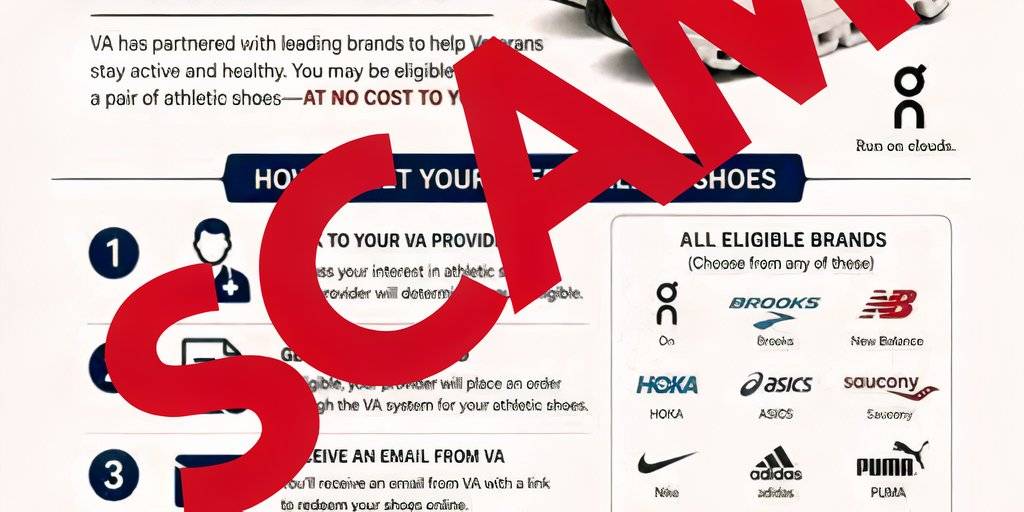
Williams’ case is a microcosm amid concerns regarding other scams targeting veterans.
Citing Federal Trade Commission (FTC) data, Kevin Lilley, a senior digital content manager at military advocacy group the Military Officers Association of America (MOAA), said Monday that military members, veterans and military families reported losing $684 million to fraud in 2025.
According to a 2025 survey by AARP Research, 39% of veterans had been solicited by someone claiming to represent the VA or another government agency. Another 28% believed their veteran status made them a target.
More than a quarter said they had lost money to fraud, with most losing over $500.
AARP also found veterans are more likely than non-veterans to receive repeated robocalls, phishing attempts, and fraudulent “benefit assistance” offers that exploit their service background and access to federal programs.
In an effort to save veterans from scams like these, the VA joined eight federal partners in August 2024 to launch VSAFE.gov, which came with a companion hotline at 1-833-38V-SAFE.
Veterans can also file a report at reportfraud.ftc.gov or can report the fraud to the FBI’s Internet Crime Complaint Center at ic3.gov.
Read the full article here
6 Comments
Great insights on Defense. Thanks for sharing!
This is very helpful information. Appreciate the detailed analysis.
Solid analysis. Will be watching this space.
Interesting update on Former Navy Chief With Dementia Scammed Out Of $100,000, Almost Loses Home. Looking forward to seeing how this develops.
I’ve been following this closely. Good to see the latest updates.
Good point. Watching closely.