

Listen to the article
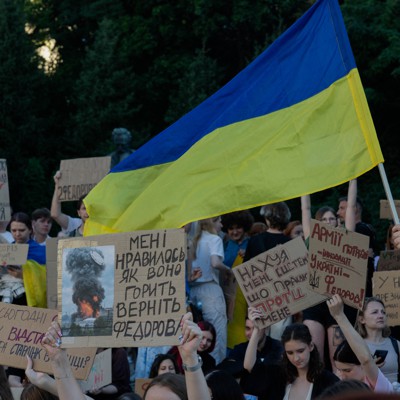
Street protests continued across Ukraine for a tenth day on Saturday in support of former defense minister Mykhailo Fedorov, whom President Volodymyr Zelenskyy fired and then attempted to placate with offers of different jobs. Fedorov is having none of it, saying on Thursday, “I will not accept any position other than Minister of Defense. No other role carries the actual authority to combat procurement corruption.” The rift has exposed rival factions at the center of Ukrainian leadership, pulling the country in opposite directions as it fights for its existence. “Game of Thrones” is how one former senior Ukrainian military official described it, and its outcome will shape the futures of Ukraine’s war effort and the country itselt.
On July 15, Zelensky fired Fedorov, his third defense minister, for feuding with his military commander-in-chief, Gen. Oleksandr Syrskyi. He first offered the job to Interior Minister Ihor Klymenko but less than a day later appointed Maj. Gen. Yevhenii Khmara. Zelensky spent the weekend in meetings with frontline commanders. On Tuesday, he replaced Syrskyi with Maj. Gen. Mykhailo Drapatyi. Khmara and Drapatyi are highly respected, non-controversial selections. But the decision-making process that brought them to their new positions continues to stir controversy.
Street protests, ignited just hours after news of Fedorov’s firing broke, grew throughout the week. At least one senior military official has resigned in solidarity. A Tuesday poll shows that 72 percent of the country disapproves of the former minister’s forced removal, and perceptions of Fedorov as trustworthy have surged from 35 percent to 65 percent in a matter of days. (Zelensky’s trust rating moved from 54 to 59 percent.)
“People aren’t marching to save Fedorov,” Olena Tregub, a former Ukrainian government official turned anti-corruption activist, wrote on July 17. “They’re marching because they fear losing the hope that Ukraine can do better.”
The Ballad of Misha
To many Ukrainians, Fedorov symbolizes aspirations for their post-Soviet country: innovation, meritocracy, entrepreneurialism, technological disruption, and especially the fight against corruption.
At 35, Fedorov was Ukraine’s youngest-ever defense minister. In his public appearances, the former software and media entrepreneur wears the Silicon Valley startup uniform: a T-shirt, jeans, and sneakers. But “Misha,” as he is widely known, has been a key player in government since 2019. Serving as the head of Ministry of Digital Transformation, he led its transition to digital record-keeping, driving the expansion of broadband infrastructure across the country, and developing deep relationships with Western tech companies such as Microsoft.
Following the Estonian e-residency model, Fedorov built out online government services and deepened the resiliency of the nation’s institutions and citizen records. When Russia launched its full-scale invasion in 2022, these digitization efforts helped ensure the continuity of government services essential to the country’s survival and economic stability.
By making government records easily accessible to the public, Federov’s digitization push also helped Ukraine battle corruption with transparent and traceable record-keeping in military acquisition. That helped keep Western aid, including military assistance, flowing into the country, and is central to Ukraine’s bid to join the European Union.
As war suffused the country in 2022, he stood up new government entities like the Army of Drones procurement program and the Brave1 platform for coordination between industry and government. He pushed for reforms on government profit caps so that Ukrainian drone manufacturers could earn a 25-percent margin, creating a Ukrainian defense ecosystem that many in Europe and even the Pentagon are now copying.
He used his personal relationship with SpaceX founder Elon Musk to secure the use of the Starlink satellite-communications service, which quickly became vital to battlefield command and control and has since enabled drone strikes across Ukraine. He also pushed to develop AI tools, such as Delta, to improve coordination and control of battlefield drones.
In January, Fedorov was appointed defense minister and quickly proposed reforms: financial incentives for military enlistment, a more institutionalized approach to recruiting foreign volunteers, and support for remote-warfare ideas that reduce the risks faced by Ukrainian soldiers. His vision included a far more roboticized front line. When this drew resistance from Syrskyi, the military commander-in-chief, Fedorov began directing funds away from conventional munitions and personnel and toward companies and projects that better reflected his preferred approach.
Serious challenges for Ukraine, including Russia’s unauthorized use of Starlink, were also addressed quickly and effectively during Fedorov’s tenure.
Very quickly, the trajectory of the war shifted. Ukraine halted and in some cases reversed Russia’s battlefield gains while risking fewer human lives.
One Ukrainian military analyst described Fedorov’s reforms as delivering “a comprehensive vision of how the war should be fought.”
But at least some thought Fedorov was overstepping his legal purview. One former senior Ukrainian military official said that the defense minister was seeking to assert control over areas of responsibility that belong strictly to the office of the commander-in-chief.
“Under Ukrainian law and NATO standards, the Minister of Defense exercises civilian democratic oversight of the Armed Forces—but has no authority to conduct operations or plan military action. His job is ensuring the Armed Forces get what they need,” the former official said.
Not everyone agrees that Ukrainian law defines the roles of defense minister and military chief so rigidly.
“Ukraine’s minister of defense is expected to ask difficult questions and evaluate whether the military system is functioning effectively. This means analyzing the broader strategic picture rather than commanding troops on the battlefield or directing military strategy. The goal is to ensure that Ukraine’s defense system is constantly learning, adapting, and improving,” Tregub, the official-turned-activist, wrote on July 21.
Fedorov also believed that his job included exposing defense ministry business practices and staff that operated to the benefit of a small handful of insiders.
In a press briefing the day after he was fired as defense minister, Fedorov defended his actions.
“We also discovered department heads within the MoD who were effectively appointed by private companies. They wouldn’t even attend MoD meetings without being accompanied by specific law-enforcement officers. We systematically fired them,” he said. “We once investigated a direct contract with a massive 200% to 300% profit margin linked to a well-known individual living outside Ukraine.”
The Butcher
If “Misha” represents many Ukrainians’ hopes for their future, Syrskyi resembles its past. As a young Soviet Army cadet, Syrskyi studied at Moscow’s Higher Military Command School; many see in him the face of Soviet bureaucracy and obsolete military thinking.
As a Ukrainian colonel-general in 2022, Syrskyi led the ultimately futile effort to hold the city of Bakhmut by sending waves of soldiers against advancing Russian forces, earning him the nickname “The Butcher.” Still, two former senior military officers said they credit him with keeping Russian gains in check—and they added that he is as tough on himself as he is on his subordinates.
In 2024, Syrskyi—a close Zelenskyy loyalist—was appointed commander-in-chief after the president fell out with Gen. Valerii Zaluzhnyi, (who holds a higher approval rating among Ukrainians.)
But Zelensky also remained close to Andrii Yermak, his political “muscle” and longtime chief of staff. Last November, Yermak was forced to step down by corruption charges, but has remained influential among high-ranking officials.
As one former senior Ukrainian defense official put it, “Syrskyi is a Yermak man.”
A malevolent force
For many Ukrainians, particularly younger ones, corruption is almost a phantom, malevolent force. Moscow has long used bribes, officials, secret deals, and off-the-books transactions to weaken Ukraine’s public institutions and bend them to its will. That was especially true during the presidency of Viktor Yanukovych, a staunch ally of Russian leader Vladimir Putin.
The 2014 “Revolution of Dignity” that ousted Yanukovych was as much an exorcism of corruption as it was an ejection of Russian imperial control. The two concepts are intimately bound for many Ukrainians.
Yanukovych lives in a Moscow suburb today. But the self-dealing decadence of his era continues to constrain Ukraine’s integration with the West since foreign assistance in the form of loans and military aid remains heavily conditioned on anti-corruption efforts. Many of the nation’s young feel punished for Russia’s corruption of their society even after staging a revolution rejecting it. The use of modern information technology to create transparency, Fedorov’s work over the years, is essential if Ukraine is going to reach its full potential as a European nation.
After Yermak was ousted, Fedorov used his reformer’s aura to expand his influence across government and build popularity internationally. The former senior Ukrainian defense official said, “When Yermak was in that powerful position, Fedorov was very careful. He didn’t rock the boat. But now that Yermak is weakened and Zelensky is weakened, Fedorov is moving forward and stepping out. And so he’s pushing the boundaries.”
In his July 16 press conference, Fedorov stopped just short of accusing Syrskyi of criminality, describing him as a man who “prefers to attend backroom meetings, weave intrigues.” But the hidden meaning in the summary was hard to mistake by anyone familiar with Yermak’s reputation.
Ukrainians who speak to Western journalists are cautious when addressing corruption, lest they reinforce negative stereotypes. This caution makes the recent widespread protests across Ukraine all the more remarkable, signaling a public willingness to confront internal problems directly, even when doing so carries political risk.
One Ukrainian military analyst, who declined to name Syrskyi specifically, said, “There are forces within the Ukrainian state that continue to operate according to the rules of the past and seek to resolve issues through old methods. Although Minister Fedorov has attempted to counter such practices through his reform agenda, the influence of these forces within the defense sector remains strong.” The former official pushed back on notions of Fedorov as a knight among villains, suggesting instead that he was a court noble vying for influence, backed by his own faction.
“You have to assume that every single leader and commander in Ukraine has a commercial interest. Every seat has a certain value attached to it. You protect it, but you also have vested interests that must be protected because those people helped put you in that position. So Fedorov obviously has a lot of different vested interests,” the former official said.
The former official pointed to government-funded media platforms he launched and a generation of drone and defense-tech startups that are now attracting lucrative Western investment after starting with government funds and grants secured by Fedorov. Fedorov has no public financial interest in any of them, but “hidden ownership” is something of an Eastern European tradition, they explained. It’s also at the center of the charges against Yermak. Even without a specific or secret financial interest, Fedorov’s future success is intimately tied to the companies he championed.
“His interests are clashing with Syrskyi’s interests,” the former official said.
Like Game of Thrones? “Exactly,” they answered.
Winter is coming
Difficult decisions await Khmara or whoever settles into the defense minister’s office. Even as Putin contemplates a broader mobilization, filling the ranks of the Ukrainian military is growing harder as recruitment slows and draft-dodging increases.
The protests supporting Fedorov and the challenge of filling military ranks are deeply linked, “Ukraine’s mobilization crisis is not fundamentally a manpower problem. It is a trust problem,” Tregub wrote on Tuesday.
Still, sources we spoke to and voices of prominent Ukraine supporters online called the protests a sign of resilience.
The country remains under martial law and in a state of existential war. But when protesters fill the streets to voice their grievances outside the president’s office, they are not met with truncheons, tear gas, or fears for their livelihoods as they might in Russia, or even Washington, D.C. That, more than anything, shows a democracy capable of enduring.
Read the full article here
5 Comments
Great insights on Defense. Thanks for sharing!
This is very helpful information. Appreciate the detailed analysis.
I’ve been following this closely. Good to see the latest updates.
Interesting update on ‘Game of Thrones’ as Ukraine’s president, defense minister split. Looking forward to seeing how this develops.
Good point. Watching closely.