

Listen to the article
Logging cuts, also known as clear-cuts, are some of the best places to find mature bucks in the big woods. They provide a focal point in an otherwise monotonous landscape. You can also readily spot them while e-scouting. The problem is, everyone else realizes this too. While clear-cuts attract deer for bedding or browse, they also attract a lot of pressure.
Luckily, whitetails adapt regardless of hunting pressure, and logging cuts can still hold mature bucks. You just need to stop hunting them like everyone else. Take a step back and evaluate how you’re hunting an area. After that, you’ll need to get some boots on the ground, ask the right questions, and look for the subtle details everyone else overlooks.
Scouting a Clear-Cut
Whether you’re dealing with a new or familiar hunting spot, you need to ground truth a clear-cut to validate, or invalidate, its condition. E-scouting is a great starting place, but boots-on-the-ground observations will always reveal more than GPS data is able to. Clear-cuts change quickly over a few years, and what you once knew may no longer apply.
If you’ve ever walked around a logging cut, then you know there is almost always a deer trail tracing the outside boundary. Don’t waste too much time, but walk that perimeter and note every deer trail entering and exiting the cut. Drop waypoints on any hubs you find. Water holes, creek crossings, and scrapes on intersecting trails are all important details that can help you hone your scouting efforts.
At some point along the cut’s edge, you’ll see an old two-track lane where machines brought logs in and out of it. You should be able to see where that lane branches. Follow the main path first, then investigate the branches if time allows. This will give you a basic understanding of how deer move in the area.
Scouting for Buck Sign
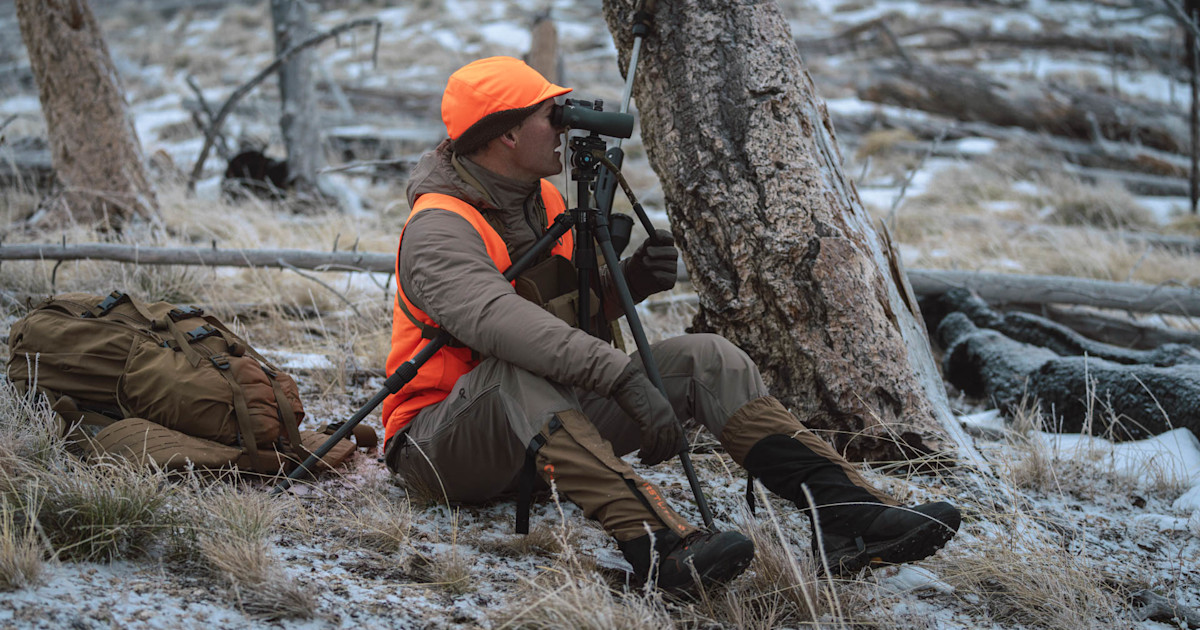
Once you have an idea of how deer generally use a specific clear-cut, you’ll need to dial in your scouting efforts to look for buck sign. Glassing, observation sits, and trail cameras are great options for gathering intel. The goal is to determine how deer are using the area during daylight hours.
Try to determine whether the deer are feeding in the cut at night and returning to timber in the morning or if they’re bedding and browsing in the heavy cover all day. It might seem like they’re bedding in plain sight, but if you’ve hunted a thick cut, you know how easily any deer can disappear. Especially mature bucks.
While you might find the obvious sign for most of the herd, mature bucks tend to operate a little differently outside of the rut. Bucks reach maturity by avoiding danger, so by the time one reaches its fifth birthday, it’s pretty good at staying alive.
A concentration of big rubs would be a great sign, but in low deer-density areas, you might not get that. Don’t overlook tracks. If you happen to find a big one, drop a waypoint or even take a picture. That way, you can compare it to others that you find.
The Subtleties
In a logging cut, not every trail belongs to a mature buck, but it can pay to follow a few obscure trails. You just need to find a place where a mature buck can loaf for extended periods of time and let his guard down.
One old buck I scouted over a few years spent a good portion of his time feeding in a clear-cut. Occasionally he daylighted there, and I always wondered what was different on those days. One summer while scouting, I found a giant bed tucked between a pine and a laurel bush. It was in the direction he usually entered the cut. I figured that had to be a place he would spend the last minutes of daylight before making an appearance.
A deer trail led away from that bed and down a steep, rocky hillside that seemed like a place most deer would avoid. At the bottom, the terrain leveled into a flat dotted with smaller rocks. In the center of the flat, without much surrounding cover, there was a scraggly tree. It wasn’t much, but it was enough to break up a buck’s outline.
Behind that tree was another giant bed. A well-worn trail wrapped around it with fresh scat nearby. It didn’t scream typical hill country buck sign, but it taught me to stop making assumptions about mature bucks.
Find A Weakness
Even mature bucks let their guards down. There will always be a place and time where he feels a false sense of security. It’s our job as deer hunters to figure that out.
A lot of times, these places happen to be staging areas. Maybe it’s a transition or a soft edge that leads from a clear-cut into the timber. Sometimes you might find a track in these places or a rub near a subtle trail. You might find browsing sign that other hunters overlook. Other times you’ll have to listen to your gut and just hunt it with the best possible conditions.
Either way, experience and observation are the best teachers. Pay attention to the small details and create theories based on what you find. If it doesn’t work, keep trying. That’s half the fun of it.
Read the full article here
6 Comments
I’ve been following this closely. Good to see the latest updates.
Interesting update on How to Scout Clear-cuts. Looking forward to seeing how this develops.
Great insights on Hunting. Thanks for sharing!
Solid analysis. Will be watching this space.
Good point. Watching closely.
This is very helpful information. Appreciate the detailed analysis.