

Listen to the article
Battery voltage can be used to estimate state of charge when the battery is fully at rest, with no charging or electrical load. The first table shows typical flooded lead-acid battery voltages for 6V, 12V, 24V, and 48V systems. A separate AGM chart follows because AGM batteries have different resting-voltage values.
Flooded Lead-Acid Battery State-of-Charge Voltage Chart
These are typical open-circuit voltage readings for flooded lead-acid batteries.
Measure the battery after 6 to 24 hours at rest, with no charging or electrical load.
| State of Charge | 12V Battery | 6V Battery | 24V Bank | 48V Bank |
|---|---|---|---|---|
| 100% | 12.73V | 6.37V | 25.46V | 50.92V |
| 90% | 12.62V | 6.31V | 25.24V | 50.48V |
| 80% | 12.50V | 6.25V | 25.00V | 50.00V |
| 70% | 12.37V | 6.19V | 24.74V | 49.48V |
| 60% | 12.24V | 6.12V | 24.48V | 48.96V |
| 50% | 12.10V | 6.05V | 24.20V | 48.40V |
| 40% | 11.96V | 5.98V | 23.92V | 47.84V |
| 30% | 11.81V | 5.91V | 23.62V | 47.24V |
| 20% | 11.66V | 5.83V | 23.32V | 46.64V |
| 10% | 11.51V | 5.75V | 23.02V | 46.04V |
Typical values at 77-80°F after 6-24 hours at rest. Readings vary by
manufacturer, temperature, battery age, and condition. Use the battery
manufacturer’s specifications when available.
At 67–70°F, resting voltage may read about 0.01V lower per 12V battery. This small difference usually does not materially change the state-of-charge estimate. For hydrometer readings, subtract 0.004 for each 10°F below 80°F.
Quick reference: A fully charged 12V flooded lead-acid battery typically reads about 12.73V at rest. At 50% state of charge, it reads about 12.10V.
I created the following chart with colors identifying 70-100%, 40-60%, 20-30%, and 10% state-of-charge ranges.
👉 Download full-size PDF (Flooded Lead-Acid Battery State-of-Charge Chart)
Typical AGM Battery State-of-Charge Voltage Chart
AGM batteries have different resting-voltage values at the same state of charge. The following chart is based on published Trojan AGM battery data. Intermediate 10% values are interpolated.

👉 Download full-size PDF (AGM Battery State-of-Charge Chart)
Guidelines For Measuring Battery State-of-Charge Voltage
A battery’s state of charge (SOC) is a measurement of how much energy remains, expressed as a percentage. It’s like a fuel gauge. Measuring and knowing the SOC of a battery or battery bank is useful when applying to alternative energy, or any other situation where you need to know its condition.
There are several ways to determine a battery’s SOC.
- Measure the battery’s chemistry (specific gravity) with a hydrometer (accurate method).
- Measure its voltage with a voltmeter while open-circuit, no load (general approximation).
- Track the current flow in and out of the battery with a ‘shunt’ and associated metering circuit (common with alt-energy systems).
Battery Voltage Measurements Are Only Approximations
Note: Voltage measurements are only approximate to determine SOC. Measuring battery voltage is not the most accurate way to do this (there are variables to consider). But it is a good generalization. A more accurate method is to measure the specific gravity of each cell within the battery. However, for many batteries, this is difficult or impossible (AGM batteries, for example). Many off-grid battery systems use a shunt-based battery monitor to track current flowing into and out of the battery bank to determine an accurate state-of-charge.
Measure Battery While “At Rest” “Open Circuit”
For best accuracy when measuring battery voltage, the battery must be in an ‘open circuit’ condition (at rest, or ‘resting’).
This means that the battery must not be under load, and it must not be charging.
To be somewhat accurate, the battery should be in that condition for an hour or two before taking a measurement, while for a more accurate measurement, you should wait 6 hours up to 24 hours.
Battery Voltage vs Temperature
Battery voltages are temperature-dependent. In fact, good charger systems (alt-energy systems) have temperature compensation built-in via a temp probe on the battery. The voltage values in these charts are based on published manufacturer data at approximately room temperature.
Flooded-Battery Specific-Gravity State-of-Charge Chart
Specific gravity can be measured only on flooded batteries with removable caps and accessible electrolyte. It cannot be measured directly on sealed AGM batteries.
| State of Charge | Specific Gravity per Cell |
|---|---|
| 100% | 1.277 |
| 90% | 1.258 |
| 80% | 1.238 |
| 70% | 1.217 |
| 60% | 1.195 |
| 50% | 1.172 |
| 40% | 1.148 |
| 30% | 1.124 |
| 20% | 1.098 |
| 10% | 1.073 |
Hydrometer Battery Measurement Tip
Note: If testing specific gravity (deep-cycle flooded/wet batteries), when drawing a sample from the battery, fill and drain the hydrometer several times before settling upon a measurement. One of my previous battery banks was a set of 6V lead-acid batteries. I measured them regularly and noticed more accuracy when doing it the way I just described.
As an Amazon Associate I earn from qualifying purchases (no extra cost to you).
The most popular hydrometer on Amazon is used for measuring the specific gravity of a lead-acid battery with access to its chemistry:
→ Battery Hydrometer
Avoid Routinely Discharging Lead-Acid Batteries Below 50%
For longer battery life, avoid routinely discharging a lead-acid battery below 50% state of charge. Occasional deeper discharges may be acceptable, but repeated deep cycling generally shortens battery life.
Generally speaking, the less you discharge the battery before recharge, the longer the battery will last. Most alternative-energy systems using lead-acid chemistry and/or AGM type, are designed to keep the battery bank at least 50% or higher. I try not to let my battery bank drop below 70% (AGM batteries configured at 48V).
The Resting Voltage of a Fully Charged Battery is not the Charging Voltage
The 100% state-of-charge voltage is not the recommended charging voltage (which will be higher, and multi-stage). See your battery manufacturer’s recommendations regarding charging voltage specs.
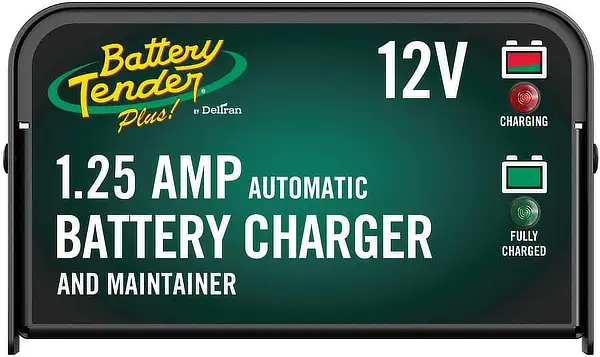
My Preferred 12 Volt Battery Charger Maintainer:
→ Battery Tender Plus 12V Charger Maintainer(Amazon)
I use the Battery Tender Plus for charging/maintaining (trickle charging) my various 12V batteries. Mowers, 4-wheelers, snowmobiles, generators, etc. It’s the most popular of its type on the market. I’ve had two in operation for many years. Great product.
👉 Lead-Acid Batteries – State Of Charge versus Freezing Temperature
👉 Lightweight 12V Deep Cycle Trolling Motor Battery
Read the full article here
6 Comments
Interesting update on Lead-Acid Battery Voltage Chart: 6V, 12V, 24V & 48V State of Charge. Looking forward to seeing how this develops.
This is very helpful information. Appreciate the detailed analysis.
Great insights on Hunting. Thanks for sharing!
Good point. Watching closely.
Solid analysis. Will be watching this space.
I’ve been following this closely. Good to see the latest updates.