

Listen to the article
Some lucky deer hunter will eventually shoot a whitetail with antlers bigger than those atop the buck Milo Hanson killed Nov. 23, 1993, near his Saskatchewan farm.
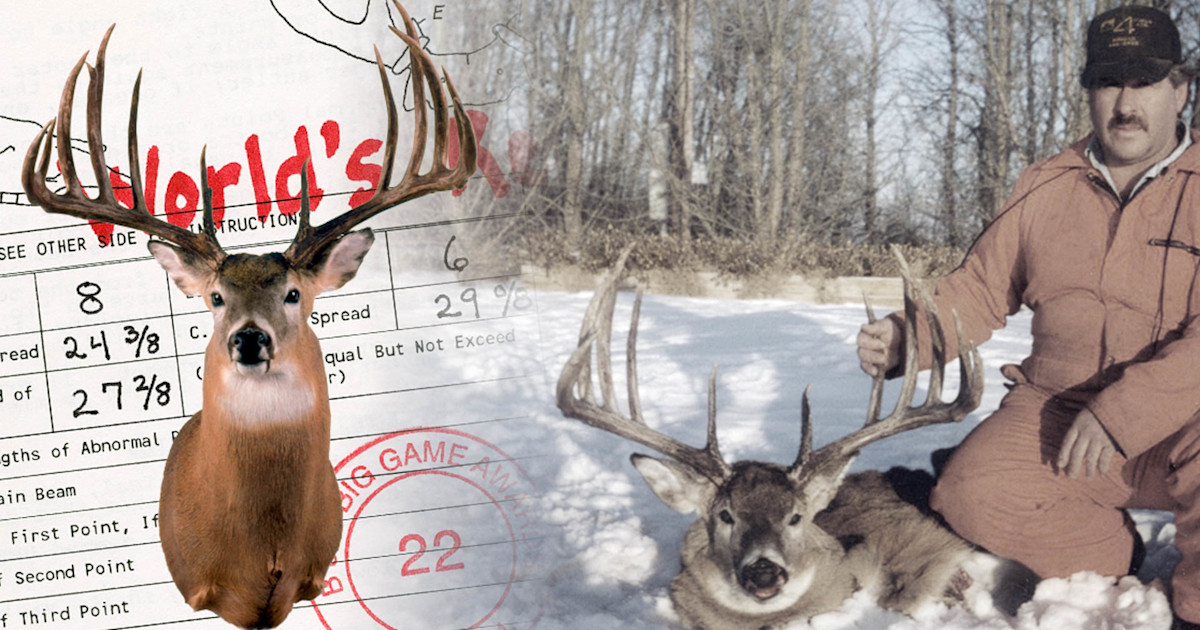
With a certified score of 213-5/8 inches, Hanson’s 14-point buck became the world-record “typical” whitetail during the Boone and Crockett Club’s 1995 awards ceremony. It bumped a 10-point buck from the top spot it held since its 1971 entry. That buck scored 206-1/8 inches, and was shot by Jim Jordan in 1914 near Danbury in northwestern Wisconsin.
No hunter, however, will ever tell a better, more modest hunting story about a world-record buck than the one Hanson told until his death Feb. 9 at age 81. Unlike many big-buck stories today, Hanson’s tale includes no nickname for the buck. Neither does it include treestands, box blinds, long waits, and trail-cam photos documenting the buck’s life through annual antler growth. And it certainly doesn’t feature GoPro video clips capturing Hanson’s shots, and smartphones grabbing his post-kill reactions.
During the buck’s estimated 4½ years, Hanson’s friends, passersby and neighboring farmers sometimes saw it crossing or feeding in one of the sprawling rye or wheat fields near Biggar, a prairie town of 2,000 in central Saskatchewan. They usually stopped to watch until it vanished into an aspen bluff or willow slough.
Even though Biggar’s hunters, farmers, and coffee-shop patrons were calling it “the huge guy” by November 1993, they didn’t consider the buck legendary. As Hanson and his co-author, Ian McMurchy, said in their 1995 book, World Record Whitetail: The Hanson Buck Story, the big whitetail simply didn’t live long enough to earn a nickname. The last buck to earn such acclaim—the so-called “Argo buck”—lived southwest of Biggar so many years that Hanson suspected “a succession of bucks was responsible for (its) legend.”
They started recognizing the buck and sharing stories about its monstrous antlers a year before Hanson shot it. One local, a school-bus driver named Jim Angelopoulos, spotted it several times on his route in autumn 1992. He said its body wasn’t big, but its gigantic antlers looked like a rocking chair atop the buck’s head.
On opening day in ’92, Angelopoulos saw the buck standing broadside near a slough 100 yards off the road. Two hunters in a truck in front of his yellow bus, and two more in a pickup behind him, never saw the buck as they rolled down the rural road. Angelopoulos assumed his school bus distracted the hunters.
Then came Hanson’s turn in 1993. Hanson, who was 49 that year, never sought the spotlight but remained humble under its glare during his final 32 years. When he retold his deer story, he sounded no different from any other hunter you hear at taverns, wedding receptions or company picnics.
Likewise, instead of bragging or claiming expertise, Hanson credited his three longtime hunting buddies for his good fortune. Their names were Walter Meger, who worked at a nearby feed lot; and Rene Igini and John Yaroshko, who owned farms next door to Hanson.
Hanson and his buddies had no luck the first week of Saskatchewan’s November 1993 deer season. However, a neighbor named Dwayne Zagoruy missed a shot opening day when the buck burst from thick aspens, raced across a harvested field and crossed into land he couldn’t hunt. The next day, Meger and another friend, Walter Gamble, spotted the buck on posted land at dusk. Meger saw it again the next morning while driving to Hanson’s farm, but it didn’t offer a good shot.
As the season’s second week began, a light snow Monday night covered old deer tracks. Hanson had to finish feeding his cattle as dawn arrived Tuesday, so Meger and Igini started hunting without him. They soon spotted the giant buck with two does several hundred yards away in a stubble field as they pulled out of Igini’s driveway. They parked and slipped away from their trucks and set up to shoot, but then missed. The buck fled to a distant aspen patch while the does ran elsewhere.
Hanson and Yaroshko arrived just as their friends finished looking for signs of a hit. They quickly organized a push. Igini waited while his three friends drove around toward the aspens where they last saw the buck. Hanson and his buddies then split up to cover the buck’s likely escape routes, and Igini followed its tracks. Just as Igini entered the aspens, the buck fled across the field, giving Hanson his first look at its giant rack. Hanson, Meger and Yaroshko all shot, but no bullet touched the buck.
Tracking the buck wasn’t easy because its hoofs were about the size of an adult doe’s, and blended in with other deer tracks crisscrossing the fields. Eventually, they jumped the buck again in another aspen patch, and watched it race across a rye field, jump a fence and disappear into a willow slough.
Igini stayed behind to track the buck while Hanson and the others drove off to wait east and northwest of the slough. Soon after Igini resumed tracking, the buck broke cover again, racing broadside at 150 yards to Hanson and Yaroshko. Their shots missed again, and the buck raced toward another aspen patch.
Igini stayed on its track while his friends again circled ahead to post near the buck’s latest hideout. When the buck fled Igini again, it burst into a field northwest of the aspens and ran straight away from Hanson and his Winchester 88 lever-action rifle. Hanson bought the rifle and its Weaver 4X riflescope in 1970 at Biggar’s hardware store for $189.
When Hanson fired, his .308 bullet struck the buck’s right antler beam, knocking it to its knees. It quickly jumped back up and disappeared over an aspen bluff 500 yards away. After Yaroshko and Hanson followed and crested the bluff, Hanson saw the buck facing him at 50 yards. His first shot dropped the buck, and a follow-up shot finished it.
In the years that followed, Hanson often took grief from judgmental hunters who questioned his marksmanship and his ethics for shooting at running deer. Still others belittled the buck’s rack, saying its high score was all length and little girth. Hanson learned to smile and stay cool, reminding himself that envy makes people bitter.
Besides, he never intended to kill the world’s biggest buck, and no one was more surprised than him when the Boone and Crockett Club’s scoring system made it so. But once B&C put Milo Hanson’s name atop its record book, he handled the distinction with world-class grace and humility.
Over 30 years later, Hanson’s buck remains number one.
Feature image via Boone and Crockett Club
Read the full article here
6 Comments
Great insights on Hunting. Thanks for sharing!
Interesting update on Milo Hanson is Gone, But His Record Buck Still Stands. Looking forward to seeing how this develops.
Good point. Watching closely.
I’ve been following this closely. Good to see the latest updates.
This is very helpful information. Appreciate the detailed analysis.
Solid analysis. Will be watching this space.