

Listen to the article
A new, 400,000-acre testing and training facility aims to bring troops and defense firms together so they can innovate at the speed of modern warfare.
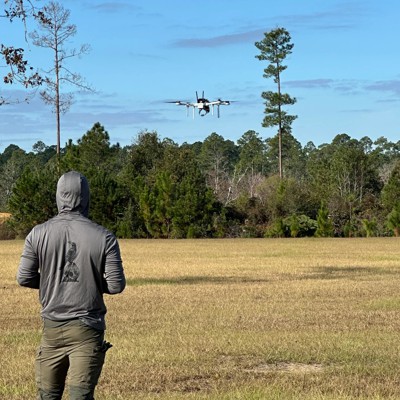
On Friday, Georgia-based Second Bend Labs announced the public opening of the facility near Moody Air Force Base. It’s designed to appeal to two usually separate groups whose challenges can only be solved together. Soldiers need to test drones and counter-drone equipment against a competent adversary, and drone startups need to see if their stuff works.
That requires a new approach to the military test range: a site that civilians can easily access, unlike a military base, and that allows military drone testing, unlike a regular expanse of private acreage.
Simply creating a place where a young company can fly medium-sized drones at the altitude of an A-10 Warthog and have soldiers shoot at it might seem obvious. It isn’t. It’s a problem that Deputy Defense Secretary Steve Feinberg discussed in his confirmation hearing as a major obstacle to modernization, and that Government Accountability Office and the Pentagon’s acquisition undersecretary have called burdensome to innovators. It’s also a problem that Ukraine has solved out of necessity, making the wartorn country a central testing site for drone and counter-drone warfare.
“You need to train the way you fight in realistic mission environments,” said Stu Booker, a former Air Force combat controller who is now Second Bend’s president of unmanned and autonomous systems. “Our clients, whether they are testing new technology, developing new tactics, or sharpening existing skills, are doing it in conditions that reflect the complexity of the environments they will actually fight in.”
The site offers diverse terrain and five miles of riverfront water for testing land and sea drones. It sits within Moody’s Corsair South Military Operations Area, which enables testing of low-altitude air support craft like the A-10 Warthog but also, increasingly, small and medium drones.
The facility has a range complex designed to Defense Department specifications, a 3,000-square-foot hangar, and an adjacent 20-foot launch pad. It also has “personnel in private guest home lodging, chef-supported meals, a 2,000-square-foot gym, and 3,000 square feet of team bonding spaces,” according to a press release for the lab. The idea is to create something akin to a modern co-working space or even a tech accelerator, allowing startups to collaborate and share gear. Think back to the Silicon Valley campuses of Google, Facebook (before Meta), and Twitter (before X) in the 2000s.
One thing the company is still working on is getting changes or waivers to local and federal regulations that limit its ability to replicate jamming and other electromagnetic warfare effects—the biggest factor driving evolution on the Ukrainian battlefield.
Second Bend Labs CEO Sam Kellett said he had reached operating agreements with the nearby Air Force base and the state of Florida. He also touted the willingness of federal officials to visit the site and discuss easing regulations—something the Defense Department has been pushing to increase the realism of testing and training.
“Our first government group will come out at the end of this month to start planning that. So there’s nothing set in stone that we can or can’t do. Okay, if somebody says they want to do something, we go find a way to make it happen for them,” said Kellett.
Why the need
One senior enlisted military official said other testing and training sites don’t make it easy for soldiers and engineers to do realistic drone-on-drone warfare, which changes far faster than Cold War-era testing sites or weapon designs under the constraints of programs of record.
The senior enlisted official said, “The rise of drones and counter-drone systems has forced us to dramatically expand the scope and frequency of training and testing. It’s no longer enough to strictly focus on shooting, moving, communicating.” Modern warfare has created a need for other skills such as analyzing electronic warfare conditions, identifying difficult-to-detect drone threats, and modifying equipment. “That means more repetitions, more scenario-based training, and more live or realistic test environments where drones are actually flying,” they said.
Practicing those skills requires more frequent contact with the people actually creating those technologies, people who aren’t easily found on military bases.
“My operators aren’t just users anymore, but they are also testers and evaluators. Every new piece of gear means building a mini test plan, running iterations, capturing data, and feeding that back to developers and higher headquarters,” they said.
The facility quietly hosted the 123rd Air Force Special Tactics Squadron in March and other military elements in previous months.
It has also hosted a handful of defense startups, younger companies that don’t have their own ranges and who aren’t accustomed to navigating the Defense Department’s complex procedures. These include Red Cat, a startup drone company; and a drone and counter-drone company called T3i.
Sean Sorensen, T3i’s director of small unmanned aerial systems, said conventional test ranges are too “static.”
Today’s ranges lack “the ability to rapidly integrate and evaluate new systems—especially prototype solutions from startups,” Sorensen said in an email. “We need more interactive training and testing locations because drone and counter-drone threats evolve faster than traditional ranges and curricula can keep up.”
CEO Kellett also leads a biometric wearables company called Aware Custom Biometric Wearables. He said 2BL is blending the two to offer “next-gen human performance technology in development that will measure brain activity and vitals in realtime,” as well as other new tech that startups might want to test against gear from other startups.
Kellett said some of the early visitors to the site have also expressed interest in setting up production facilities nearby, in line with the growing Defense Department preference for a closer design, testing, and supply chain.
Read the full article here
6 Comments
I’ve been following this closely. Good to see the latest updates.
Solid analysis. Will be watching this space.
Interesting update on New test range opens for the startup-war era. Looking forward to seeing how this develops.
This is very helpful information. Appreciate the detailed analysis.
Great insights on Defense. Thanks for sharing!
Good point. Watching closely.