

Listen to the article
When the Pentagon’s science and technology chief looks at Ukraine, he sees a war fought with weapons invented, produced, and fielded since the conflict erupted.
“The fact that you can bring relevant capability to the fight, as the Ukrainians and allies have done in the conflict with Russia, that essentially didn’t exist at the beginning of the fight,” Joseph Jewell, assistant defense secretary for science and technology, said Tuesday at the Defense One Tech Summit in Arlington, Virginia. “That’s the new thing here.”
It’s a thing the United States must learn to do, Jewell said.
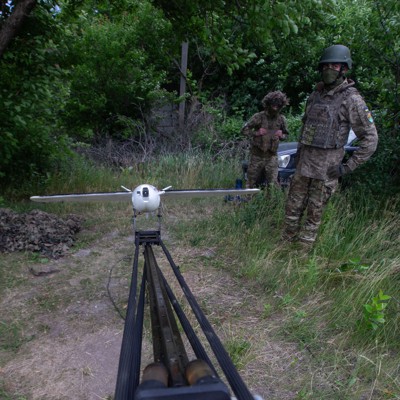
Ukraine’s homegrown drone industry “to a large extent, sprung up almost overnight because of urgency. I think with our industrial resources, we certainly could do things at that scale and even in a more sophisticated way. And we need to do it,” he said.
Jewell noted that Ukraine has taken the Russian Navy out of the fight without much of a navy of its own.
“The way they were able to do that, well, there are several things. First of all, their weapon systems were small, relatively undetectable. Second of all, they had a lot of them,” he said.
There is still a need for expensive, highly capable weapons, Jewell said, “But the exquisite effect may be helped along by leveraging a hundred or a thousand drones controlled by AI. And I think that’s what we’re starting to see modern warfare evolve into. Now, of course, the model is a lot of people in Ukraine who are actually manually controlling these first-person drones. I think the natural evolution of that is AI-controlled or AI-enabled.”
Patent holiday
One way the Pentagon is trying to speed up innovation is by making it easier for defense companies to use government-held technological patents.
The Defense Department holds tens of thousands of patents, but only takes in about $20 million a year from them. In January, Jewell’s boss, Defense Undersecretary for Research and Engineering Emil Michael, announced a “patent holiday” under which private companies can license some of those patents—about 500, Jewell said—free of charge.
He said the first no-fee patent license was granted last month. As of mid-June, 14 patents have been “signed out” for commercial use, one has been licensed for a fee by a company that wanted exclusivity, 36 more are pending, and 145 more applications have come in, he said.
Biotech
Jewell lauded the promise of biotech combined with AI. He cited a new bioengineered thermal coating that may help drones obscure their heat signatures, developed through BioMADE, a DOD-sponsored Manufacturing Innovation Institute.
He also described an experiment in which Marines in the Pacific used 3D printers and other tools to field-produce shaped charges with local materials: plastic water bottles, crushed volcanic rock, coconut husks, and coffee grounds.
“They all detonated, actually; the volcanic rocks were most effective,” he said. “The thing that’s amazing to me is this was 3D-printed. You effectively have 99% reduced the time to point-of-use, because you could make it in the field from materials that are endemic in the Indo-Pacific.”
What’s more, the Marines’ shaped charge “had 25% better focusing characteristics than conventionally manufactured high explosives,” he said. “So we envision a future where you have a containerized production facility for potentially the ingredients for that, potentially including the 3D printer to pump out the shaped charges. And then you can drop, say, a CONEX box in the field where you need, so it can produce biodiesel, it can produce jet fuel.”
Read the full article here
6 Comments
This is very helpful information. Appreciate the detailed analysis.
Good point. Watching closely.
Great insights on Defense. Thanks for sharing!
Solid analysis. Will be watching this space.
Interesting update on Shaped charges from coffee grounds? Pentagon science chief describes future of war. Looking forward to seeing how this develops.
I’ve been following this closely. Good to see the latest updates.