

Listen to the article
Ask most Americans what the Coast Guard does, and the answer stops at helicopter rescues. That’s real, and it’s the most visible part of the job, but it’s a fraction of what the smallest of the six armed services is actually responsible for on any given day. By law, the Coast Guard operates under 11 statutory missions, ranging from stopping drug cartels to keeping the Great Lakes shipping lanes open through the winter. Here’s what that actually looks like.
Drug Interdiction: The Numbers Are Genuinely Staggering
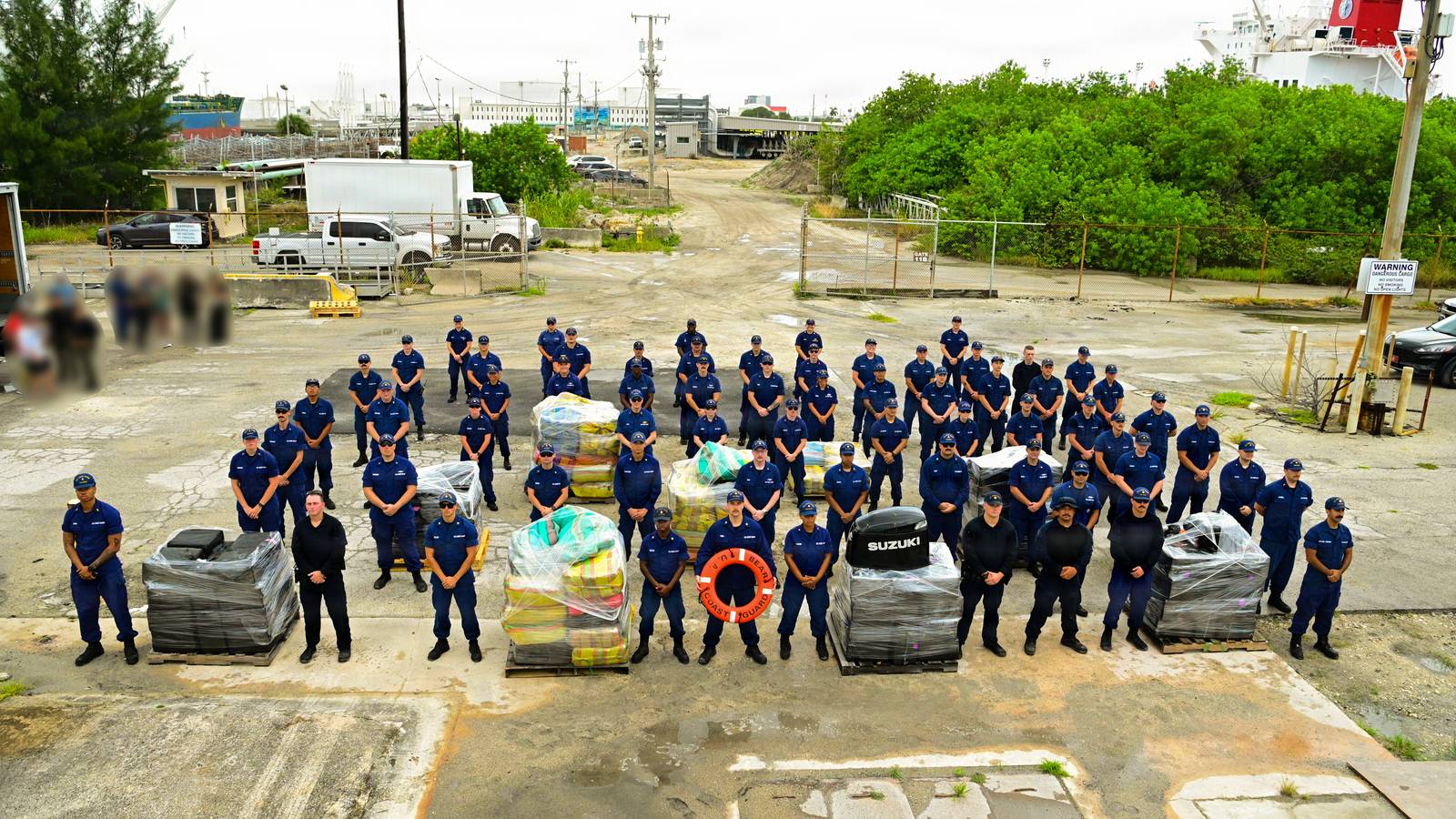
The Coast Guard is the lead federal agency for maritime drug interdiction, and the race isn’t close. In fiscal year 2023, the service intercepted more than 212,000 pounds of cocaine. That pace has only accelerated. In March 2026, the Coast Guard hit a single-month record of more than 80,000 pounds of illicit drugs interdicted. That August, Coast Guard Cutter Hamilton offloaded more than 76,000 pounds of drugs in Florida, including 61,740 pounds of cocaine and 14,400 pounds of marijuana valued at $473 million, the largest single drug offload in Coast Guard history.
These aren’t abstract statistics gathered from a desk. A typical interdiction starts with detection and monitoring by the interagency Joint Interagency Task Force South, based in Key West, Florida, which tracks aerial and maritime drug trafficking across the Eastern Pacific and Caribbean. Once interdiction becomes imminent, operational control shifts to the Coast Guard.
In February 2026 alone, the crew of Coast Guard Cutter Seneca offloaded more than 17,750 pounds of cocaine worth over $133.5 million in Port Everglades, Florida, the result of four separate interdictions in a single patrol, including one in which a Helicopter Interdiction Tactical Squadron aircrew used airborne use-of-force tactics to stop a go-fast smuggling vessel before boarding it.
Migrant Interdiction and Border Security
The Coast Guard also serves as a maritime border security force, a mission that expanded significantly in 2025. In January 2025, Coast Guard crews and resources were surged nationwide to support expanded border security operations, including direct involvement assisting deportation flights in California and Texas. The service also launched Operation River Wall, patrolling roughly 260 miles of the Rio Grande River in Texas. A January 2026 Government Accountability Office report found that in response to the highest maritime migration levels in more than 30 years, the Coast Guard made real operational tradeoffs, prioritizing migrant interdiction in ways that pulled resources from some of its other missions.
Search and Rescue: Where the Public Perception Comes From
The Coast Guard covers more than 95,000 miles of U.S. coastline and 4.5 million square miles of Exclusive Economic Zone, plus international waters, as the nation’s primary maritime first responder. In 2025 alone, Coast Guard crews responded to major flooding in Western Washington with 17 separate air missions to rescue victims and assess damage. During catastrophic flash flooding in Texas, Coast Guard aircrews from Air Stations Corpus Christi and Houston rescued or helped evacuate more than 200 people. During ex-typhoon Halong in Western Alaska, Coast Guard crews saved 34 lives and evacuated 28 more people to Bethel, while also overseeing cleanup of more than 500 gallons of spilled fuel to protect Alaskan waters from the same storm.
Keeping the Water Move-able: Aids to Navigation and Ports
Every mariner in the country, commercial or recreational, depends on a piece of Coast Guard infrastructure they may have never thought about: a nationwide network of more than 50,000 aids to navigation, including buoys, lighthouses and electronic aids, maintained and serviced continuously so vessels can safely transit U.S. waters. On top of that, the Coast Guard conducted 33,370 vessel inspections and 16,012 facility inspections in a recent operating year, helping facilitate the movement of more than 1.8 billion tons of cargo through U.S. waters — supporting a maritime commerce economy projected to move $5.4 trillion in goods to, from and within the United States in 2026.
Under its Captain of the Port authority, the Coast Guard can direct ports open or closed, and it manages vessel traffic on the country’s most critical waterways, a level of unilateral regulatory authority most federal agencies simply don’t have.
Icebreaking: A Mission Many People Have Never Heard Of
The Coast Guard operates the nation’s polar icebreaking fleet, keeping shipping lanes open in Alaska, the Great Lakes and the St. Lawrence Seaway, and supporting scientific and strategic operations in the Arctic and Antarctic.
Every winter, as the Great Lakes’ Soo Locks close for the season, the Coast Guard launches Operation Coal Shovel to keep commercial shipping moving through ice-choked waters. In the Arctic specifically, the Coast Guard has been actively expanding its presence: The service commissioned its sixth Arctic District Fast Response Cutter, Coast Guard Cutter Frederick Mann, in Kodiak, Alaska, in 2026 — the Coast Guard’s 60th Fast Response Cutter overall, designed for missions spanning search and rescue, fishery patrols, drug and migrant interdiction, and national defense across the Aleutian Islands, Bering Sea, Gulf of Alaska and North Pacific.
Marine Environmental Protection and Living Marine Resources
The Coast Guard enforces U.S. and international law protecting marine ecosystems, regulates and inspects vessels to reduce the risk of pollution incidents, and leads response efforts when spills do occur. It also enforces fisheries law protecting an industry that supports more than $240 billion in annual U.S. economic activity, at a time when nearly 20 percent of assessed fish stocks are considered overfished.
A Force That Also Fights, If Called On
Beyond its civilian-facing missions, the Coast Guard maintains a defense readiness role and can be transferred to operate directly under the Department of the Navy during wartime or when the president directs it, a provision that’s been used during both world wars. Under its current modernization plan, known as Force Design 2028, the service describes itself explicitly as both a member of the Department of Homeland Security team and part of the joint military force that defends the country.
Add it all up, and the picture that emerges is a service that spends its days doing counternarcotics operations that look a lot like small-scale naval warfare, running a regulatory apparatus that keeps trillions of dollars in trade moving, breaking ice for oceangoing commerce, and still being the crew that shows up first when someone’s boat goes down or a flood strands a family on a rooftop. The rescue helicopter is real. It’s just one job.
Read the full article here
6 Comments
I’ve been following this closely. Good to see the latest updates.
Interesting update on The Coast Guard’s Missions Extend Far Beyond Search and Rescue. Looking forward to seeing how this develops.
This is very helpful information. Appreciate the detailed analysis.
Great insights on Defense. Thanks for sharing!
Solid analysis. Will be watching this space.
Good point. Watching closely.