

Listen to the article
Ukraine’s success in decimating Russia’s Black Sea Fleet without having a Navy of its own is “case alpha” in finding new ways to employ robots across land, sea, and air, Rear Adm. Doug Sasse said Monday. But the U.S. Navy can’t just copy Ukraine’s homework and apply it to the vast, well-observed Pacific, or even the Red Sea, where it’s now tasked with enforcing a naval blockade and “getting a lot of unmanned stuff thrown at us,” the head of the Navy’s assessment said.
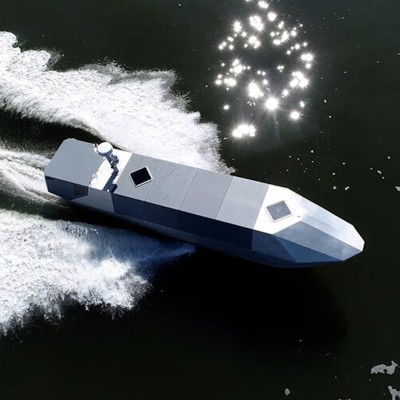
The Navy last week took possession of its first unmanned “Sea Hawk” large robot ship. It will deploy as part of the Theodore Roosevelt strike group in the Pacific later this year, he said.
Capt. Garrett Miller, commodore of Surface Navy Development Group One, said the Sea Hawk will be joined by “thousands” of small unmanned ships and “any number” of aerial drones by 2030 in the Pacific alone. Sasse and Miller made their remarks at the Navy League’s Sea-Air-Space conference.
Ukraine was able to sink much of Russia’s Black Sea Fleet in 2024 with just a fraction of that many sea drones. That model “shows great promise [for unmanned ships] in a very constrained sea, where you can get right up to the edge of the land-sea interface and hide things in [dense forest,] get it in the water really quickly, and it doesn’t have to run an incredible distance,” Sasse said. But “when you look at what’s going on in the Pacific, there are no trees to hide behind as you’re coming across … You’re sitting on the surface of the ocean, maybe under observation entirely,” while crossing, he said.
Operation Epic Fury in the Red Sea has also highlighted the importance of human naval crews, even as Iran’s relentless attacks with one-way Shahed attack drones illustrate—similar to Ukraine’s experience—how cheap drones can eat away at a larger military’s advantage.
The U.S. Navy would like to keep its advantage, so its focus right now is integrating more robots into a larger manned fleet, Sasse said. That provides a different set of challenges.
“Once you start saying, ‘All right, it’s gotta travel with a fleet. And it’s gotta keep up with a carrier strike group [which can travel at speeds above 35 miles per hour across vast distances.] It’s got to have range. It’s got to have 30 days endurance… And it’s gotta be cheap. All those things are violently opposed. Suddenly that [unmanned surface vehicle] that’s traveling as part of a strike group starts to look like a frigate or a [guided missile destroyer],” Sasse said.
The United States has deployed its own sea drones to the CENTCOM area to support current operations, said Rear Adm. Derek Trinque, director of the Navy’s surface warfare division. But those were for “expanding the battle space awareness and ensuring that our forces are more effective as a broader team,” he said—not for attack.
The U.S. doesn’t have a shortage of weapons to sink ships. But the mission of enforcing a naval blockade after lambasting Iran for trying to do the same means the United States can’t use attack robots in the same way as its adversary.
“Just look at the examples from this past weekend, where USS Spruance interdicted a blockade runner,” Trinque said. “You need manned platforms for that.”
That means that even as the Navy adds thousands of robot ships, the “command and control will remain as it is,” Trinque said. “There will still be commanders and commanding officers who have the accountability for the proper utilization of all of our systems, including unmanned … I expect that we will see some centralization of the warfighting development for unmanned systems. And so where we have aviation and surface [warfare tactics instructors] right now, we might have robotic and autonomous systems [instructors] in the future.”
Still, the rise of robot weapons is already influencing ship design and informing new concepts. The Navy will deploy a wide variety of air, sea, and undersea drones aboard already existing frigates and destroyers—within specific containers that work with the ships’ existing frames. But as new unmanned ships like the medium unmanned surface vessel, or MUSV, come online, the look of the Navy will change more rapidly, even as the human-decision making remains central to command and control.
“We built 30 years of growth in the Arleigh Burke class [of guided-missile] destroyers because we had to,” Trinque said. “And we’re going to build 30 to 40 years of growth into the battleship. And we are going to build growth into the frigate. But for MUSVs, we don’t have to do that because we can get more advanced MUSVs as they become available.”
Read the full article here
6 Comments
I’ve been following this closely. Good to see the latest updates.
This is very helpful information. Appreciate the detailed analysis.
Solid analysis. Will be watching this space.
Great insights on Defense. Thanks for sharing!
Interesting update on Why the US can’t copy Ukraine’s robot navy. Looking forward to seeing how this develops.
Good point. Watching closely.