

Listen to the article
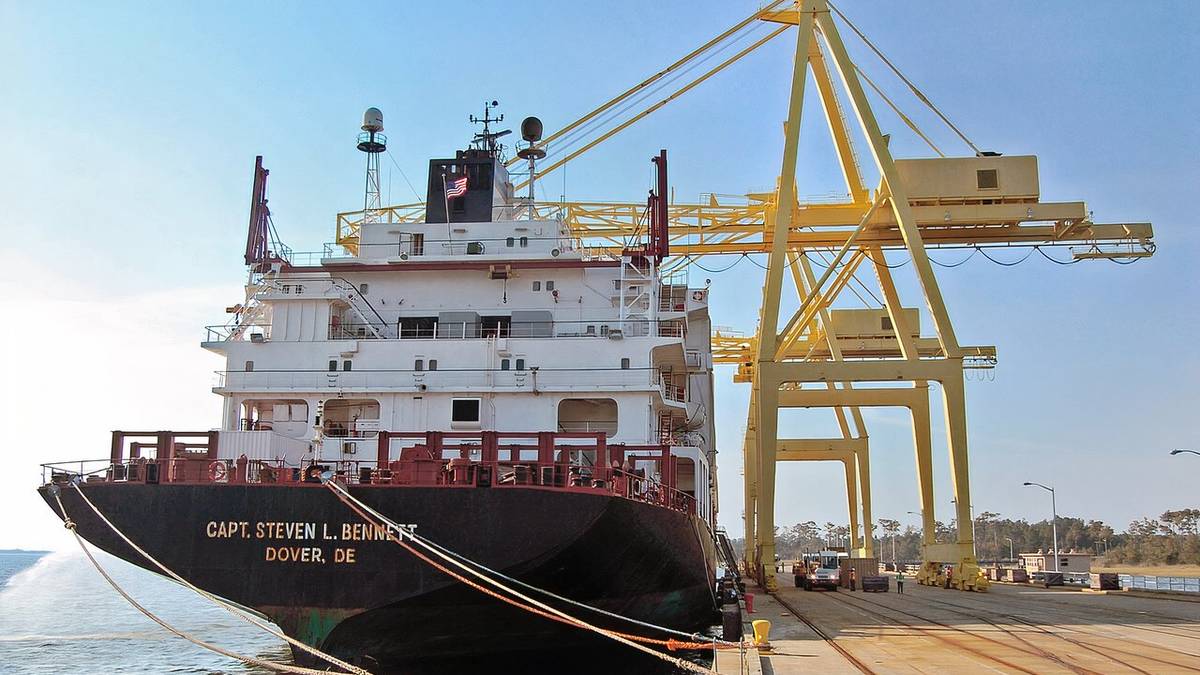
Government defense ships arriving and departing North Carolina’s Military Ocean Terminal Sunny Point (MOTSU) will benefit from a newly completed project by the U.S. Army Corps of Engineers Wilmington District.
Engineers recently finished a $6.3 million dredging project consisting of annual maintenance dredging, removing hundreds of thousands of cubic yards of sediment to ensure the area’s federally authorized navigation channels remain open and operational.
In a typical year, approximately 500,000 to 600,000 cubic yards of sediment is dredged up and transported to the Ocean Dredged Material Disposal Site, an offshore placement area designated for dredged material.
“MOTSU is an ocean terminal, so the waterways must be deep enough for vessels to maintain missions,” Clare Williams, navigation project manager with the Wilmington District, said in a statement. “If the vessels can’t make it in, the mission is compromised.”
The project at MOTSU is part of the Corps’ navigation mission and its ability to safely receive and deploy ships in support of national defense. The annual work removes naturally accumulated sediment from MOTSU’s federal waterways and restores channels to their authorized depths.
The project, taking place at one of the largest military terminals in the world, supports the import and export of weapons, ammunition, explosives and military equipment for the U.S. Army.
Mechanical Dredging Used Over Environmental Concern
The dredging work is environmentally delicate, requiring the use of the DB Catalina—the largest mechanical dredge in the Western Hemisphere with low emission rates.
“The Catalina’s emissions are about one-tenth of a typical dredge, which is impressive for its size,” Williams said, adding that the Wilmington District prefers mechanical dredges for operations near MOTSU because they generally pose a lower risk to marine life.
“Typically, a bucket dredge has fewer ‘takes’ each year. Cutterhead and hopper dredges pose a higher risk to marine life, so we prefer not to use them near MOTSU,” he added.

The dredging company Curtin Maritime performed the work between May 19 and June 19, after a different contractor finished a smaller portion of the work. Both carried out mechanical dredging operations, which require less pipeline infrastructure, and help limit interference with shipping traffic.
If a vessel is coming, under orders or leaving, the dredge must stay out of the way. That requires heightened coordination between the contractor, the Corps and the customer.
Another challenge with the annual dredging project involves environmental restrictions. MOTSU is home to several protected species, including sturgeon that nest and breed in the area.
Officials said dredging schedules are planned around those environmental restrictions, with an eye toward maintaining the terminal’s critical navigation infrastructure while protecting sensitive ecological habitats.
“MOTSU supports and protects a number of critically endangered species,” Williams said. “And we will continue to support that part of the mission as well.”
Active Military Port Critical to National Defense
Built in 1951 and opened in 1955, MOTSU is located on an Army-owned 8,500-acre site on the banks of the Cape Fear River, about 16 miles south of Wilmington.
While much of the dredging work took place out of public view, officials said the work is an important part of maintaining the nation’s waterways and supporting national defense.

The port has transferred munitions to every major armed conflict since it was established. It was especially active during the Vietnam and Persian Gulf wars, where 466,000 tons of cargo were transferred through MOTSU.
The annual dredging work keeps the channels open and the nation ready. Each bucket of sediment that’s removed helps ensure ships can safely navigate to and from MOTSU. The port can handle up to six ships simultaneously, with large cranes used for loading and unloading ships.
Read the full article here
6 Comments
Solid analysis. Will be watching this space.
Interesting update on Army Engineers Complete $6M National Defense Project Aiding Shipping Lanes. Looking forward to seeing how this develops.
I’ve been following this closely. Good to see the latest updates.
Great insights on Defense. Thanks for sharing!
Good point. Watching closely.
This is very helpful information. Appreciate the detailed analysis.