

Listen to the article
A Navy veteran’s breakthrough research could make it easier for doctors to detect pneumonia in children.
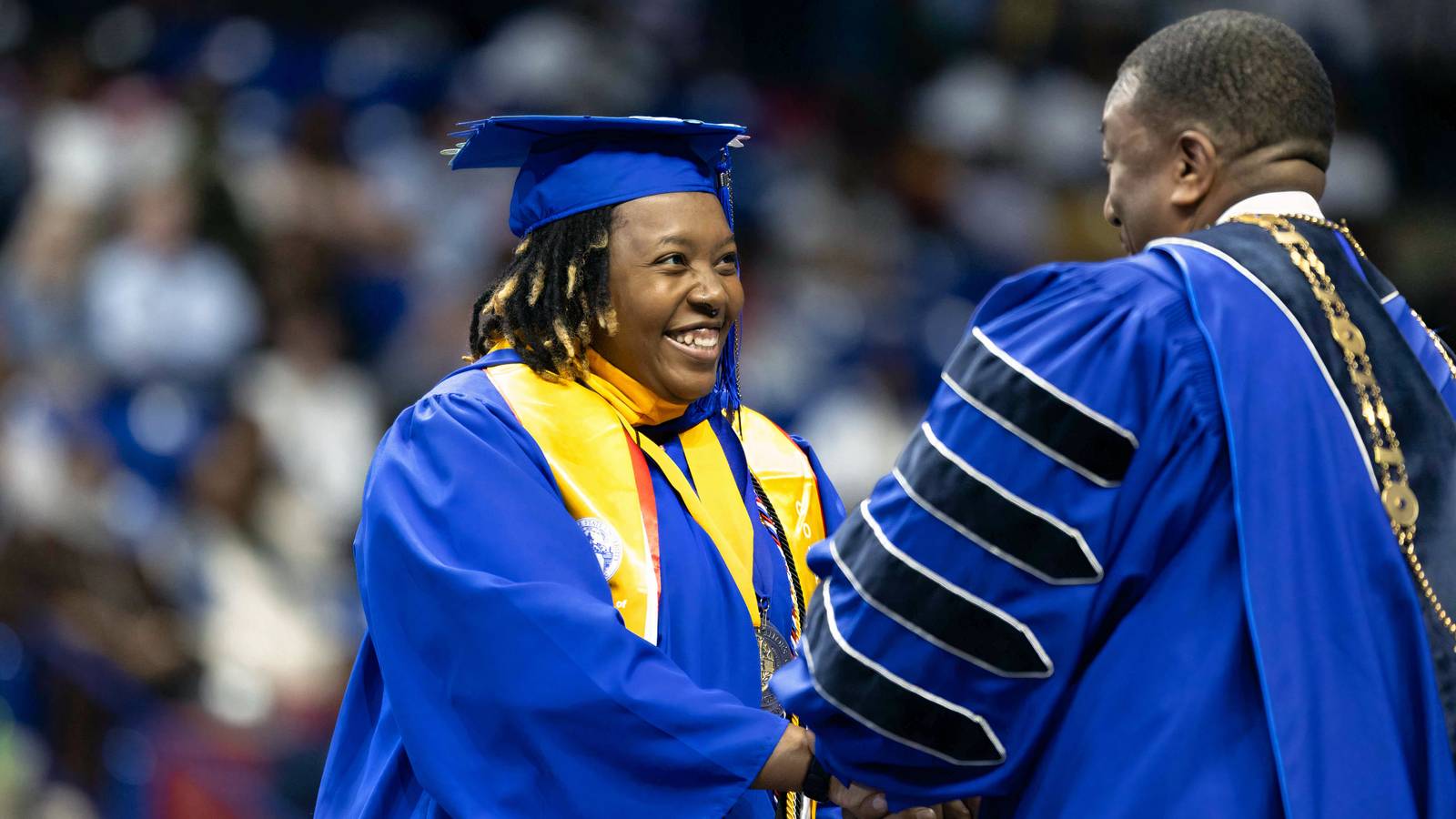
Shereiff Garrett, who recently earned a bachelor’s degree in computer science from Fayetteville State University (FSU) in Fayetteville, N.C., won first place in a national competition by using artificial intelligence (AI) in pediatric X-rays to spot pneumonia, which can sometimes lead to hospitalization and even death in small children.
In March, Garrett took home the top prize in the Computer Science and Information Management oral presentation division at the Emerging Researchers National (ERN) Conference in Atlanta. Garrett had stiff competition. The contest, hosted by the American Association for the Advancement of Science and the National Science Foundation, featured 400 presentations and more than 700 participants.
Garrett used her Navy training and technical aptitude to wow the contest’s judges. She also had personal motivation driving her to succeed.
Garrett’s younger brother suffered through a debilitating fight against pneumonia, leading her to search for ways to improve medicine through AI to give patients faster, more efficient results. The Navy veteran and first-generation college graduate worked with mentors Chandra Adhikari, Ph.D., and Bhoj Gautam, Ph.D., to develop her project, while also focusing on graduating this spring.
“Research is a big way of giving back to humanity and also leaving a legacy behind that will continue to serve others when I’m long gone,” Garrett said in a press release.
She wanted to build something practical that could detect pneumonia in its earliest stages. Every year, about 2.5 million people die from pulmonary illness globally. In the U.S., more than 40,000 patients die from it annually, with infants, small children under five years old and older adults over age 65 being the most vulnerable groups.
“Pneumonia is one of the most critical conditions where early identification can truly make a difference,” Garrett said. “Having that detection capability could save lives.”
Garrett also wanted to push beyond simply creating an AI model. She focused on making her technical work accessible by sharing the story that motivated her research.
“I’ve always loved stories,” Garrett said. “I thought, if I share my work as a story, maybe people will be able to follow along and truly understand.”
She plans to continue to pursue her passion for medical AI, hoping to help others. In a few months, Garrett will start a doctoral computer science program at Johns Hopkins University in Baltimore, Maryland.
From the Navy to Ph.D. Candidate
Garrett hasn’t been one to take a conventional path toward higher education.

Before entering FSU, she served in the Navy for three years, working as a gas turbine mechanic. She also logged time as a truck driver.
A podcast inspired her to return to school and study computer science. Connecting with the right mentors led her to create an AI model to help doctors and an award-winning research project at a national competition.
Along with Dr. Adhikari, Garrett praised the university’s Department of Basic Energy Sciences Program and the McNair Scholars Program for helping her bring a simple idea to life.
It’s not the first time Garrett has received accolades. In 2014, while serving on the USS Chancellorsville (currently known as the USS Robert Smalls), Garrett was honored with a Navy and Marine Corps Achievement Medal for saving the ship during a rogue drone incident.
Based on a report from the Navy, in November 2013, an aerial target drone malfunctioned, striking the USS Chancellorsville, causing damage and injuring two sailors with minor burns. The drone punctured a hole in the side of the ship, and the guided missile cruiser had to return to San Diego, California, its home port, for repairs.
Garrett was part of a record number of graduates at FSU last weekend. The university handed out 1,003 bachelor’s degrees and 1,247 total degrees during ceremonies on May 9-10.
Read the full article here
6 Comments
I’ve been following this closely. Good to see the latest updates.
Great insights on Defense. Thanks for sharing!
Good point. Watching closely.
Interesting update on Navy Veteran Wins Top Honors for Using AI to Detect Pneumonia in Children. Looking forward to seeing how this develops.
Solid analysis. Will be watching this space.
This is very helpful information. Appreciate the detailed analysis.