

Listen to the article
Drones have transformed modern warfare, but the way warfighters control them has changed surprisingly little. Most small, unmanned aircraft still rely on handheld controllers, tablets or virtual reality interfaces that force operators to divert attention from the battlefield. PYRRHUS Aeronautics believes that approach creates a critical vulnerability, and the Georgia-based defense technology company has built a system designed to eliminate it.
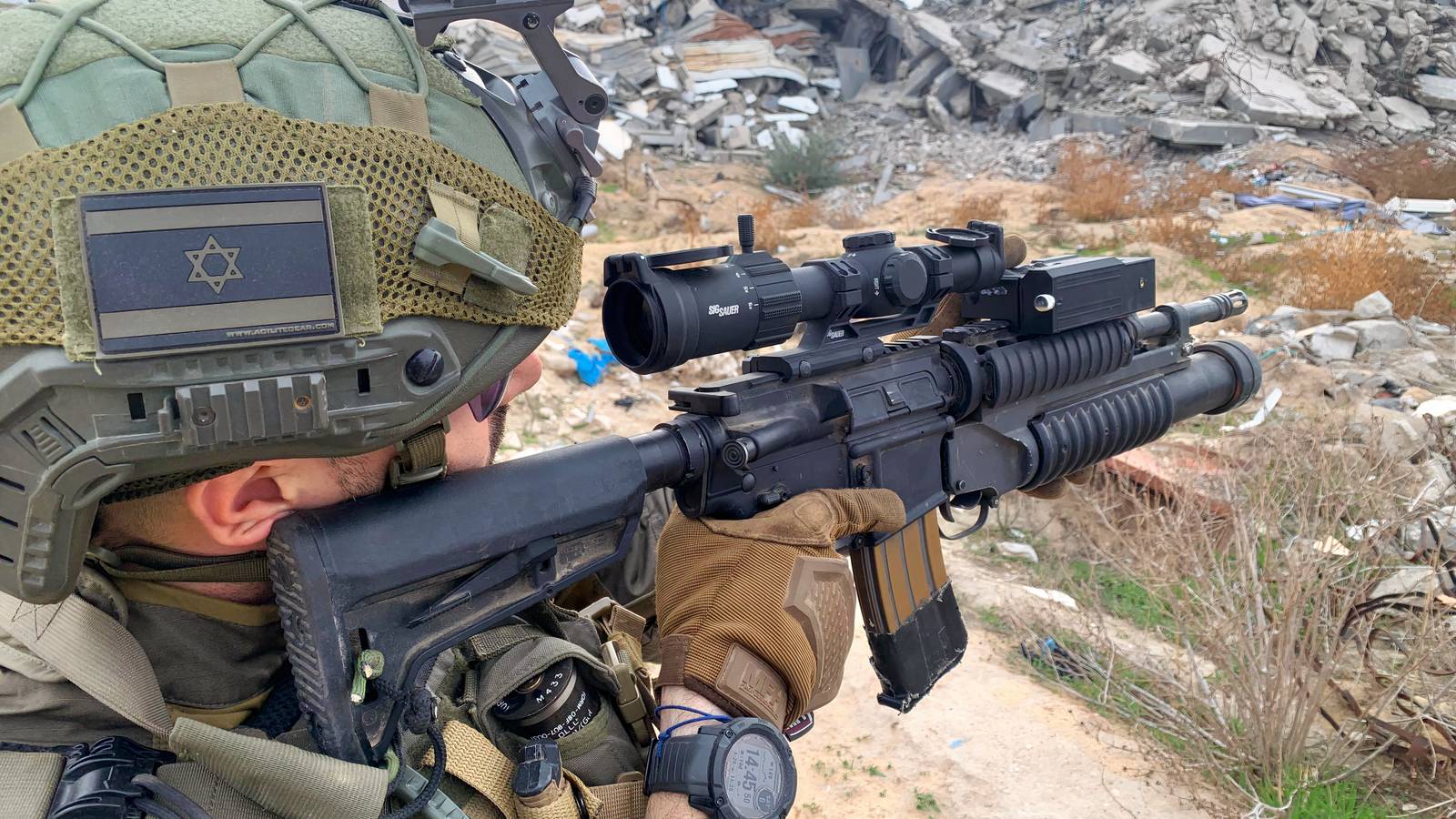
The company’s flagship & 1st product, LADRS, or Laser Aiming & Drone Remote System, allows troops to control drones directly from a rifle-mounted device rather than a traditional joystick.
According to Co-Founder and CEO Elad Amar, the goal is straightforward: keep soldiers focused on the fight while making drones easier to operate. Amar, an IDF infantry veteran who continues to serve as a reservist, said the concept emerged from firsthand experience.
“I had the idea while people were shooting at me,” Elad said during an interview with Military.com. “We need to change how we use drones because it’s putting troops in danger.” Amar’s vision became a reality with the help of his Co-Founder, Dr. Leandro Gryngarten, a Georgia Tech graduate who currently serves as CTO of PYRRHUS.
Later, the startup joined a defense-focused startup accelerator, ASTRA, in partnership with Starburst and Israel Aerospace Industries (IAI), builder of the Arrow Missile Defense System.
Keeping Soldiers on the Rifle
The central idea behind LADRS is simple. Rather than forcing a soldier to lower a weapon and pick up a controller, the system uses the rifle itself as the interface.
“At a simple level, instead of using joysticks, you’re going to use your rifle and your natural movement on the battlefield to direct and control very complex missions,” Amar said.
The concept addresses a contradiction Amar believes has developed as drones became commonplace in military operations.
“Since day one in boot camp, they tell you not to take your hands off the rifle,” he said. “Now we’re often forcing soldiers to do that to use all the extra technology we have.”
LADRS allows operators to point, designate and execute drone missions through a combination of rifle orientation, laser guidance and button inputs. The system is designed for short-range tactical reconnaissance missions such as clearing buildings, scanning terrain and conducting battlefield surveillance.
Amar said one military unit evaluating the technology summarized its value in a phrase that immediately resonated with him.
“It allows me to keep soldiers on the trigger instead of a joystick,” he said.
Amar argues the system could also reduce one of the military’s less visible challenges: training drone operators. Traditional drone programs often require extensive instruction and often rely on a relatively small pool of specialists. Because LADRS uses movements infantry troops already understand, he believes the learning curve can be dramatically shortened.
To test that assumption, Amar turned to an unlikely evaluator.
“I did the ‘grandma test,’” he said. “But my grandma is dead, so I went to my mother.” After confirming she had never handled an M4 or flown a drone before, he handed her a rifle equipped with LADRS and asked her to fly the aircraft. “Within five minutes, she was flying the drone.”
“You don’t need any specific skills. You just need the ability to shoot a rifle,” Amar said. “It doesn’t take 200 hours to train. It’s less than an hour. You’re going to learn, you’re going to get the hang of it.”

Designed Not to Add More Weight
One of the most common complaints among infantry troops is that every new capability usually also means more equipment to carry. Amar said avoiding that trap became a major design requirement from the beginning.
The result is a system roughly comparable in size to a PEQ-15 laser aiming module already familiar to many military users.
“It’s the same form factor, the same size, the same weight more or less,” Amar said. “It’s a weight that doesn’t really add anything, but gives you many more capabilities.”
According to Amar, the device weighs approximately 286 grams with batteries installed. The company deliberately avoided creating a solution that solved one battlefield problem while creating another.
“A lot of times companies come to you and say, ‘We have a new amazing system,’” Amar said. “Then you take it to the field, and eventually it does only ‘A,’ and on top of that it weighs 40 pounds.”
That focus on practicality also led to one of LADRS’ more notable features: an integrated laser designator.
During early testing, soldiers pointed out that replacing an existing rifle accessory without preserving its functionality would be a step backward.
The company responded by incorporating a laser designator into the system, allowing troops to retain a familiar capability while adding drone-control functions.
Built Around Battlefield Feedback
PYRRHUS describes itself as a “Warfighter Tech” company, a philosophy Amar said extends beyond marketing language.
“We believe that there isn’t enough emphasis on warfighters when it comes to new defense tech,” he said. “The warfighter is basically the king when we design this product.”
Amar said LADRS underwent repeated redesigns based on feedback from approximately 100 warfighters in active battlefields. Some changes were surprisingly minor. A sharp edge that caused thumb discomfort after prolonged use was contoured after testers repeatedly complained about it.
“The small things are important,” Amar said. “It’s the small things that make the system much better and much more usable.”
The company also prioritizes hiring military veterans and collecting input from conventional infantry units rather than relying exclusively on special operations personnel.
“I want to hear from the corporal in the Marines that maybe has ideas on how to make it better,” Amar said.

A Different Approach to the Drone Boom
Amar argues the defense industry does not necessarily need another drone manufacturer. Instead, he sees an opportunity to improve how soldiers interact with the growing number of unmanned systems already entering service.
The company has focused on making LADRS compatible with multiple drone manufacturers by making the LADRS drone-agnostic – a capability they are aiming to achieve by the end of 2026.
“I don’t think the market needs another drone manufacturer,” Amar said. “We need more components to enhance the capabilities of the warfighter.”
He compares the strategy to supplying tools during a gold rush.
“Everybody is going to build drones because that’s the gold rush,” he said. “We’re making the shovel.”
For Amar, the ultimate objective is not simply to make drones more autonomous or more sophisticated. It is to make them easier for ordinary soldiers to use without sacrificing awareness, mobility or combat effectiveness.
If there is one thing he wants people to remember about LADRS, it is the concept that separates it from countless other defense technologies entering the market.
“We are the first one and the only one right now to control drones in the battlefield from a rifle,” Amar said.
PYRRHUS is currently developing a 2nd product, in collaboration with a major defense Prime, that is classified at this time. The company is now preparing its next capital raise to fuel that work, a step Amar sees as essential to keeping pace with what the battlefield demands. “Every month shaved off development,” he argues, “is a month sooner that warfighters get technology built for the fight they’re going to encounter.”
Read the full article here
6 Comments
This is very helpful information. Appreciate the detailed analysis.
Interesting update on New Battlefield System Lets Soldiers Control Drones From Their Rifles. Looking forward to seeing how this develops.
I’ve been following this closely. Good to see the latest updates.
Great insights on Defense. Thanks for sharing!
Solid analysis. Will be watching this space.
Good point. Watching closely.